




Marketing budget planning is the process of deciding how much to invest in marketing, where that money goes and how you will judge whether it paid off. For most SMEs, the most reliable approach starts from goals rather than from last year’s spend. First, you work out how many leads or customers you need. Then you estimate what it costs to win them, add fixed costs and keep a reserve for testing. This guide compares the main budgeting methods and gives you a six-step process with a simple template.
Earlier posts in this series covered your marketing strategy, your ideal customer profile and how to set marketing goals and KPIs. A budget now turns those goals into resources.
Why Marketing Budget Planning Matters for SMEs
Many small companies still treat marketing as whatever is left at the end of the month. As a result, spend rises when sales are good and stops when they slow down, which is exactly when marketing is needed most.
Structured marketing budget planning changes that in several ways:
- Predictability: you know in advance what you will spend, so cash flow stays under control.
- Focus: money goes to the channels that serve your goals, instead of to the loudest idea.
- Accountability: every budget line links to a KPI, so you can see what works.
- Speed: because a reserve is already approved, you can react to opportunities without new sign-off.
In addition, a written budget makes conversations with leadership easier. It shows what marketing needs, what it will deliver and what happens if the budget is cut.
How Much Should an SME Spend on Marketing?
There is no single correct number. Budgets depend on your industry, growth stage, margins and sales model. Still, benchmarks help as a sanity check.
For example, Gartner’s CMO Spend Survey has tracked average marketing budgets of around 7–8% of company revenue in recent years. However, those respondents are mostly senior marketers at larger organisations in North America and Europe. So treat the figure as a reference point, not a target.
In practice, SMEs usually adjust in two directions. A company entering a new market, or launching a new offer, often needs to invest above its long-term level for a while. By contrast, an established firm with strong referrals may need less, although it should still invest to avoid depending on a few clients.
Three Ways to Set Your Marketing Budget
Most companies use one of three methods, or a mix of them. Each has clear strengths and weaknesses.
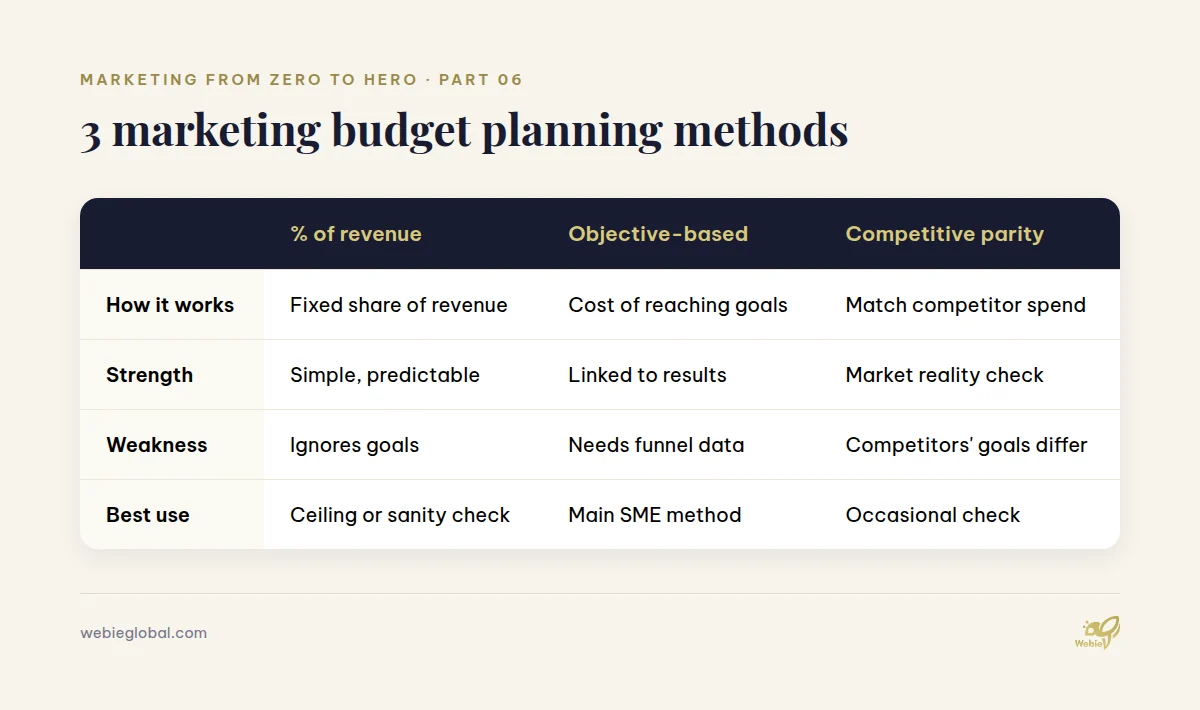
For most SMEs, the objective-based method works best, because it links spend directly to results. Then use a percentage of revenue as a ceiling, and a quick look at competitors as a reality check.
Marketing Budget Planning in Six Steps
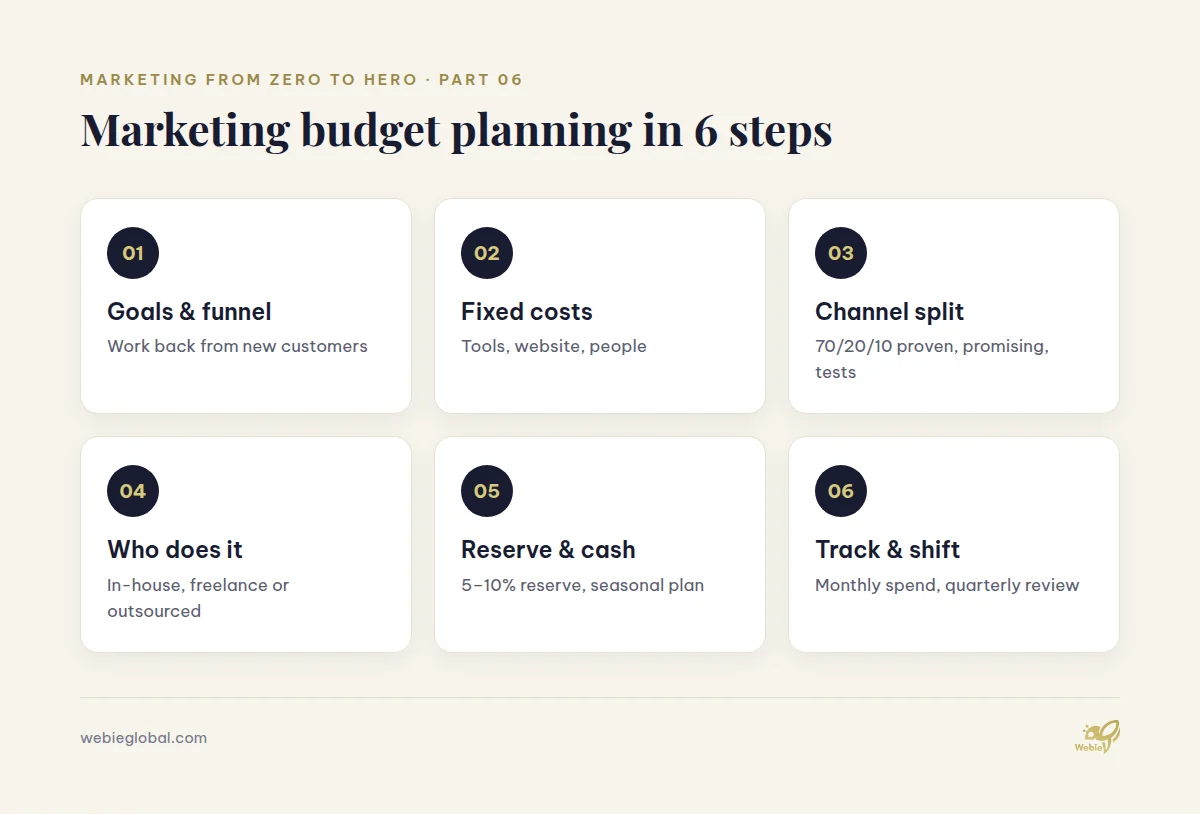
Step 1: Start from goals and funnel math
First, take the goals you set for the year, such as new customers or revenue from a new market. Then work backwards through your funnel. For instance, suppose you need 10 new B2B clients and sales wins one in four qualified leads. In that case, you need about 40 sales-qualified leads. If roughly a third of marketing leads become sales-qualified, you need around 120 marketing leads.
Next, estimate the cost per lead for each channel, using past data wherever possible. That gives you a first, goal-based budget figure.
If you have no history yet, start with small tests instead of guesses. For example, run one month of paid search with a modest budget and track cost per qualified lead in your CRM. Then use those real numbers to finalise the plan for the rest of the year. As a result, your marketing budget planning rests on evidence from your own market rather than on generic averages.
Step 2: List your fixed costs
Before you allocate channel money, list the costs that do not change with results. These typically include:
- Marketing software, such as CRM, email and analytics tools
- Website hosting, maintenance and security updates
- Salaries, retainers and recurring freelance work
- Brand assets, events you have already committed to and memberships
Fixed costs are easy to underestimate. So check contracts and invoices from the last 12 months rather than working from memory.
Step 3: Allocate channel budgets with a 70/20/10 split
Now divide the variable budget between channels. A common rule of thumb is 70/20/10. That means about 70% on proven channels, 20% on channels that show promise and 10% on experiments.
For example, a B2B services firm might keep most spend on SEO and LinkedIn, because those already bring qualified leads. It could then test Google Ads with the 20% and try a webinar with the 10%. Also check platform rules, since tools work differently. In Google Ads, for instance, daily costs can exceed your average daily budget on some days, while monthly spend stays within a set limit.
Step 4: Decide in-house, freelance or outsourced
Next, decide who does the work, because that choice shapes the budget. In-house staff give you control but add fixed costs. Freelancers are flexible, yet coordination takes time. An outsourced partner, meanwhile, can offer a whole team on a fixed-price, retainer or time-and-materials basis. So compare the total cost of each option, including management time, rather than only day rates.
Step 5: Keep a reserve and plan cash flow
Set aside a reserve of roughly 5–10% of the budget. That way, you can double down on a campaign that works, or cover an unexpected cost. Also spread spend across the year in line with your sales cycle. For example, B2B demand in many European markets slows in August and late December, so plan campaigns around those periods.
Step 6: Track, review and reallocate
Finally, compare actual spend with the plan every month. Then review results against your KPIs each quarter, and move money from weak channels to strong ones. A budget is a plan, not a promise, so adjust it when the data tells you to.
To make reviews quick, keep one simple sheet with three columns per line: planned spend, actual spend and the linked KPI. Then add a short comment whenever the numbers drift. Over time, that sheet also becomes your best input for next year’s plan.
Example Marketing Budget Planning Template
The table below is an illustrative structure for a small B2B company, not a benchmark. Replace the shares with your own numbers.
| Budget line | Share of budget | Linked KPI |
|---|---|---|
| Tools and website (fixed) | 15% | Uptime, tracking in place |
| SEO and content | 30% | Organic leads per month |
| LinkedIn (organic and paid) | 20% | Sales-qualified leads |
| Google Ads test | 15% | Cost per qualified lead |
| Events and webinars | 10% | Meetings booked |
| Reserve | 10% | Used only with a clear case |
Above all, keep one owner per budget line. In addition, record the reason for every reallocation, because it will help next year’s planning.
Common Marketing Budget Planning Mistakes
- Copying last year’s budget: instead, rebuild it from this year’s goals.
- Forgetting fixed costs: software, maintenance and retainers quietly eat into channel budgets.
- Spreading money too thin: five channels with small budgets rarely beat two channels done well.
- No reserve: without one, you cannot react when a campaign takes off.
- Judging too early: SEO and content often need several months, so review them on a longer cycle than paid ads.
- Ignoring compliance costs: consent tools and data processing agreements also belong in the budget. A later post, GDPR-Compliant Marketing: What SMEs Must Know, covers this in detail.
FAQ
What is marketing budget planning?
Marketing budget planning is the process of deciding how much to spend on marketing, how to split it across channels and costs, and how to measure the return. For SMEs, it works best when it starts from clear goals.
What percentage of revenue should an SME spend on marketing?
There is no universal figure. Surveys of larger companies often report around 7–8% of revenue. However, SMEs in growth or market-entry phases may need more, while established firms may need less. Therefore, build the number from your goals and use percentages only as a check.
How often should you review your marketing budget planning?
Track spend monthly and review results quarterly. In addition, rebuild the full plan once a year, or sooner if your goals change.
How should a small B2B company split its budget?
Start with fixed costs, then use a 70/20/10 split for the rest: proven channels, promising channels and experiments. Also keep a small reserve for opportunities.
Get More From Your Marketing Budget Planning
Good marketing budget planning is only half the job. The other half is making sure every euro reaches the right audience through a fast website, solid tracking and well-run campaigns. Webie Global supports European and international businesses with SEO and digital marketing, web development and dedicated teams. We work in English with clear processes, GDPR-aware practices and flexible engagement models. Explore our services.
If you would like a second opinion on your budget or channel mix, contact our team at huyen.dang@webieglobal.com.
Series navigation — Marketing from Zero to Hero: Previous: Setting Marketing Goals & KPIs (OKR vs SMART) · Next: GDPR-Compliant Marketing: What SMEs Must Know.