



A value proposition that converts states, in the buyer’s own words, which problem you solve, for whom, what outcome to expect and why you are the safer choice. Positioning, in turn, is the strategic decision behind it: the place you choose to occupy in the buyer’s mind relative to competitors. So get the positioning right first, and then express it as a value proposition on your website, in sales conversations and in campaigns. This guide gives European SMEs a practical five-step process, templates and a test checklist.
So far, this series has covered the foundations of a marketing strategy, how to define your ideal customer profile and a competitor analysis framework. Positioning is where those three inputs finally come together.
Positioning vs Value Proposition: What Is the Difference?
The two terms are often used interchangeably. However, they do different jobs. Positioning is an internal choice about where you compete, while the value proposition is the external promise that explains why a buyer should choose you.
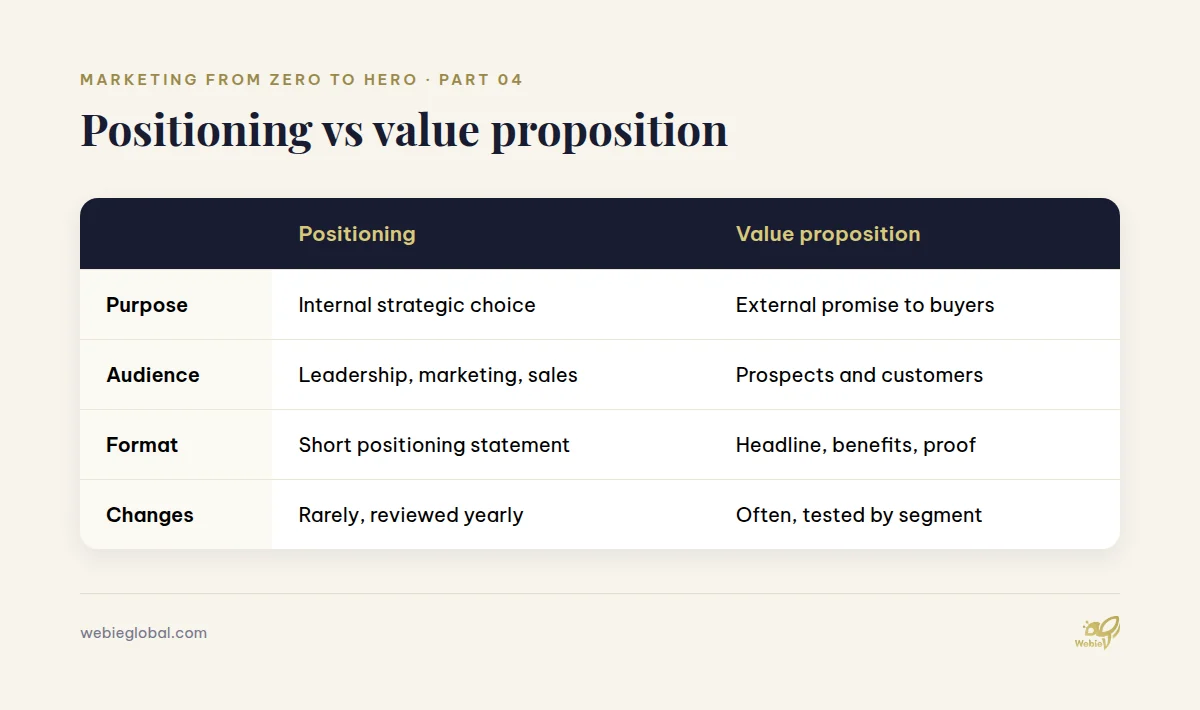
In short, positioning decides what you stand for. The value proposition then makes that decision visible and persuasive to a specific buyer. As a result, one company can have one positioning and several value propositions for different segments or buying roles.
Why Clear Positioning Matters for European SMEs
SMEs rarely win by being everything to everyone. For example, buyers in Germany, the Netherlands or France often compare several providers across borders and languages. When offers look similar, the decision then drifts towards the lowest price or the best-known name.
Clear positioning helps you avoid that trap:
- It shortens the path to the shortlist, because buyers quickly see whether you are relevant.
- It supports pricing, since a specific, credible promise is easier to justify than a generic one.
- It improves efficiency, so content, SEO and campaigns target a defined audience and problem.
- It aligns the team, which means sales, marketing and delivery describe the company the same way.
- It builds trust, because European B2B buyers tend to value clarity on process, risk and compliance.
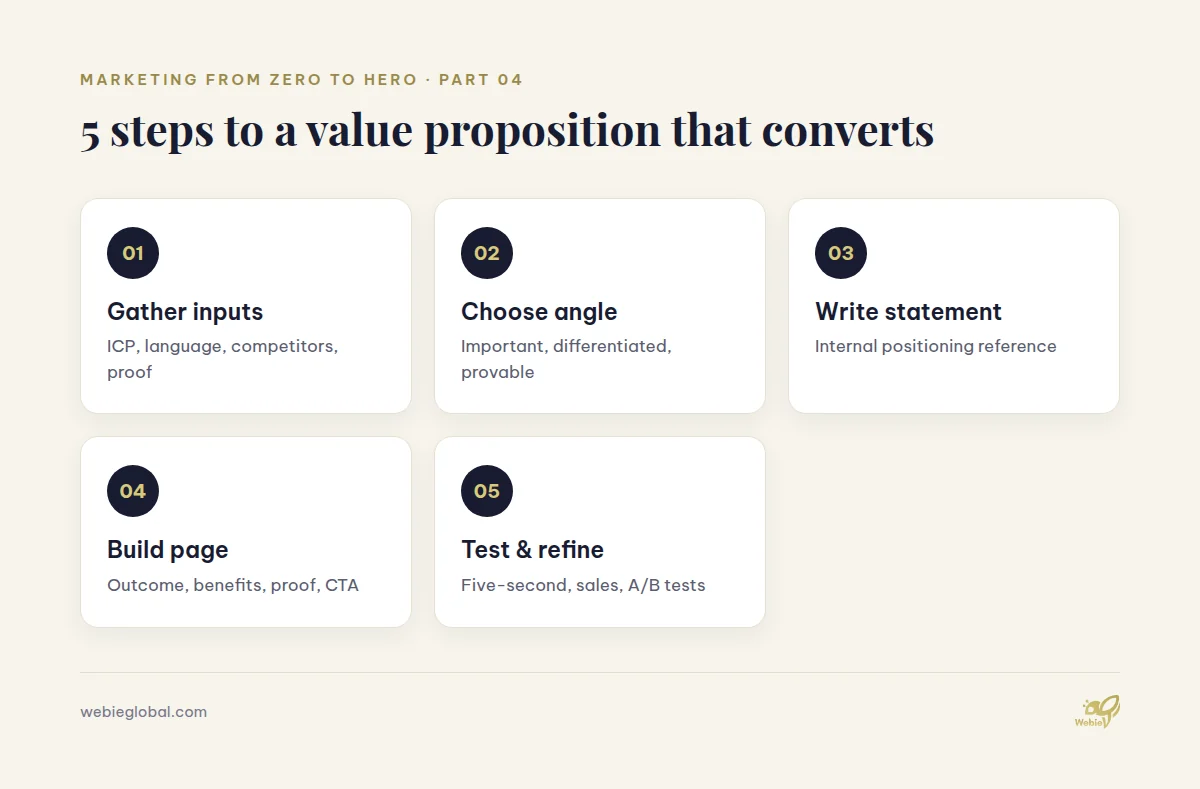
Step 1: Gather the Inputs
Positioning should rest on evidence rather than on a brainstorm. Therefore, bring together five inputs:
- Your ideal customer profile: target segments, trigger events, pains and buying committee.
- Customer language: exact phrases from interviews, sales calls and reviews.
- Competitor analysis: especially criteria where competitors are weak or all look the same.
- Your real strengths: capabilities, processes and results you can prove.
- Win/loss insight: why deals were won, lost or postponed.
If one input is missing, note the gap. After all, positioning built on assumptions is the most common reason a value proposition fails to convert.
Step 2: Choose Your Positioning Angle
Most successful SME positioning uses one primary angle, sometimes supported by a second. Common options include:
| Angle | Description | Works well when |
|---|---|---|
| Niche / industry | Specialist for a defined sector | You have deep references in that sector |
| Problem | Known for solving one painful problem | Buyers search for that problem explicitly |
| Audience | Built for one type of buyer | Larger competitors underserve that audience |
| Delivery model | A different way of working | Buyers are frustrated with how others deliver |
| Risk reduction | Lower risk through process and transparency | Purchases are high-stakes |
Then test each angle against three questions. Is it important to buyers? Are competitors weak or unclear on it? Can we prove it? An angle needs three yes answers.
Also be careful with a pure price angle. It is easy to copy and tends to attract price-sensitive clients. So if cost efficiency is a real advantage, combine it with proof of quality and process.
For instance, an IT services firm could combine a delivery model angle with risk reduction. It might then lead with dedicated teams and flexible engagement models, and support that with a documented process and clear data protection terms. In that case, both angles point to the same buyer concern, so the message still feels focused.
Step 3: Write Your Positioning Statement
A positioning statement is an internal reference rather than website copy. A widely used template looks like this:
For [target customer] who [need or trigger], [company] is the [category] that [key benefit]. Unlike [main alternative], we [primary differentiator], backed by [proof].
For example, a hypothetical consultancy might write: “For mid-sized Benelux logistics firms expanding abroad, we are the operations advisory partner that standardises cross-border processes within one quarter.” It would then add: “Unlike generalist consultancies, we work only with logistics firms and use a documented method.”
Next, check your draft against three questions:
- Could a competitor sign it without changing a word? If so, it is not specific enough.
- Would your best customers recognise themselves in it?
- Is every claim supported by something you can show?
Step 4: Build a Value Proposition That Converts
Now translate the positioning into buyer-facing messaging. A proven page structure has six parts:
- Headline: state the main outcome in the customer’s words. For instance, “Launch your platform with a dedicated team, without hiring in-house” beats “Innovative solutions for your business”.
- Sub-headline: then add one or two sentences on who it is for and how it works.
- Three benefits: link each feature to an outcome, using the pattern “[feature], so you can [outcome]”.
- Proof: show case studies, permitted references, certifications or documented methods.
- Risk reducers: address objections, such as engagement flexibility, communication rhythm, data processing agreements or a small pilot.
- One clear call to action: finally, match it to buyer readiness, for example a scoping call.
Keep the order in mind as well. Visitors first need to understand the outcome, then believe the proof and only then act. For that reason, place the headline, sub-headline and primary CTA above the fold, and move detailed proof further down.
Above all, never invent or exaggerate proof. In B2B, buyers check credibility quickly. In addition, the EU rules on misleading and comparative advertising also apply to claims made to business customers.
Step 5: Test and Refine Your Value Proposition
A value proposition stays a hypothesis until buyers respond to it. Fortunately, you can test it without a large budget:
- Five-second test: show your page to people in your target audience. Can they then say what you do and for whom?
- Sales conversations: use the new messaging for a few weeks, and note which phrases prompt interest.
- A/B testing: test headlines on high-traffic pages or in paid campaigns, one variable at a time.
- LinkedIn and email: compare reply rates for messages built on different angles.
- Search behaviour: finally, check whether your terms match what your audience actually searches for.
Then track results against the goals in your marketing plan. The next post in this series, Setting Marketing Goals & KPIs (OKR vs SMART), covers how to set those targets.
Value Proposition Checklist
- Built on ICP data, customer language and competitor analysis
- One primary angle that is important, differentiated and provable
- A headline with a specific outcome rather than a slogan
- Three benefits that link features to outcomes, as well as real proof
- Main objections addressed, such as risk, process and data protection
- One primary call to action, and messaging adapted for each market
Common Value Proposition Mistakes
- Feature lists instead of outcomes: buyers care about what changes for them, not only what you do.
- Internal jargon: terms your team uses daily may mean nothing to a buyer.
- Appealing to every segment: broad messaging usually converts no segment well.
- Unprovable superlatives: words such as “best” or “leading” need evidence, otherwise they reduce trust.
- Literal translation: instead, localise tone and formality for German, Dutch or French buyers.
- Setting it and forgetting it: markets, competitors and your capabilities change, so revisit it.
FAQ
What is the difference between positioning and a value proposition?
Positioning is the internal strategic choice about where you compete. A value proposition, by contrast, is the buyer-facing expression of that choice: the promise and proof that explain why a buyer should choose you.
What makes a B2B value proposition convert?
Specificity, relevance and proof. It names the audience and outcome, uses the buyer’s language and supports claims with evidence. It also reduces perceived risk and ends with a clear next step.
How long should a value proposition be?
On a website, the core value proposition usually fits in a headline, a short sub-headline and three supporting points. Longer explanations and proof can then follow further down the page.
How often should positioning be reviewed?
Review it at least once a year. Also review it sooner when you enter a new market, launch a new offer or notice falling conversion rates.
Turn Your Value Proposition Into Pages That Perform
A clear value proposition only delivers results when it appears consistently on your website, in search and across campaigns. Webie Global supports European and international businesses with conversion-focused web development, UX/UI design and SEO and digital marketing. We work in English with clear processes, GDPR-aware practices and flexible engagement models. Explore our services.
If you would like an outside view on how your positioning comes across, contact our team at huyen.dang@webieglobal.com.
Series navigation — Marketing from Zero to Hero: Previous: Competitor Analysis Framework for European SMEs · Next: Setting Marketing Goals & KPIs (OKR vs SMART).