




A marketing strategy for SMEs starts with four decisions, not with channels: who you serve, what problem you solve better than the alternatives, which measurable goals matter this year, and how much time and budget you can commit. Once those are written down, choosing between SEO, LinkedIn, paid ads or events becomes a practical question instead of a guess. This guide walks through a step-by-step process that a founder or marketing lead can complete in a few focused weeks. In addition, it ends with a 90-day starter plan.
According to the European Commission, 99% of European businesses are SMEs. Most of them compete without a large brand budget or a full marketing department. For that reason, a clear, written marketing strategy matters more for SMEs than for large companies: every euro and every hour has to count.
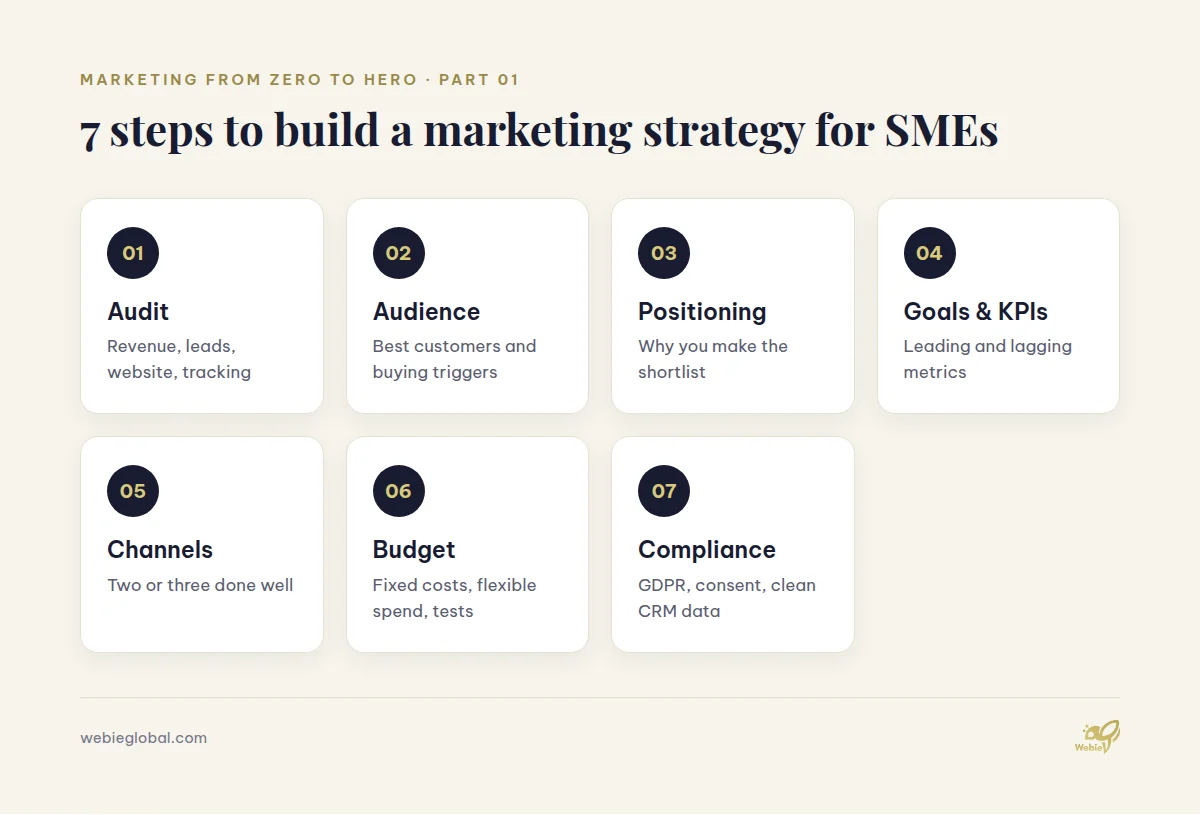
What a Marketing Strategy for SMEs Is (and Is Not)
A marketing strategy is a short set of decisions that tells your team where to focus. Just as importantly, it tells them what to ignore. It is not a 60-page document, a list of social media posts or a copy of a competitor’s tactics.
In practice, a useful marketing strategy for SMEs fits on two to five pages and answers these questions:
- Market: Which customer segments will we prioritise in the next 12 months?
- Proposition: Why should those customers choose us over alternatives, including doing nothing?
- Goals: What business outcomes should marketing contribute to, and how will we measure them?
- Channels: Where will we reach and convert those customers?
- Resources: What budget, people and tools are available, and what is outsourced?
- Rhythm: How often do we review results and adjust?
The difference between a strategy and a marketing plan is scope. The strategy sets direction, whereas the plan translates it into campaigns, content, dates and owners. So start with the strategy, then build the plan.
Step 1: Audit Where You Are Today
Before setting direction, document your starting point. An honest audit usually takes a few days. Moreover, it prevents you from repeating what has not worked.
Quick marketing audit checklist
- Revenue sources: Which customers, products and regions generate most of your revenue and margin?
- Lead sources: Where did your last 20–30 customers first hear about you? For example: referral, search, LinkedIn, trade fair, partner or outbound.
- Website: Does it clearly explain what you do, for whom, and what the next step is? Also, is it fast and mobile-friendly?
- Search visibility: Do you appear for the terms buyers use in each market language you sell in?
- Content and proof: Do you have case studies, testimonials or references you are allowed to publish?
- Data and tracking: Is analytics installed correctly, with consent management? Do you know which pages generate enquiries?
- CRM: Are leads recorded in one place, or spread across inboxes and spreadsheets?
- Sales and marketing alignment: Do both teams agree on what a qualified lead is?
Write the answers down, including the uncomfortable ones. Gaps in tracking and CRM are especially common, and they make every later decision harder.
Step 2: Decide Who You Serve
The most common reason a marketing strategy for SMEs underperforms is trying to speak to everyone. A focused target audience, by contrast, makes your message sharper, your content more relevant and your budget more efficient.
First, look at your best existing customers: those who are profitable, easy to work with and likely to buy again or refer others. Then look for patterns in industry, company size, country, buying trigger and decision-maker role.
For B2B companies, capture at least:
- La stratégie de la série company profile (industry, size, region, maturity).
- La stratégie de la série buying committee (who initiates, who evaluates, who signs).
- La stratégie de la série trigger events that create demand, such as new funding, a new market or a regulatory change.
- La stratégie de la série main objections (price, risk, switching effort, trust).
You will go deeper on this in the next article of this series, which covers building an Ideal Customer Profile in detail.
Step 3: Clarify Your Positioning
Positioning answers one question: when a target customer compares options, why should you be on the shortlist? For SMEs, strong positioning is usually specific rather than broad.
Here is a simple positioning statement template:
For [target customer] who [need or problem], [company] provides [offer] that [key benefit], unlike [main alternative], because [proof or reason to believe].
Next, test your draft against three criteria:
- Relevant: Does it address a problem the customer already recognises?
- Different: Could a competitor copy the sentence word for word? If yes, it is too generic.
- Credible: Can you back it up with process, references, certifications or results?
In European B2B markets, credibility signals often include clear processes, data protection practices, contract flexibility and responsiveness. Where these are real strengths, therefore, make them part of the message rather than a footnote.
Step 4: Set Measurable Marketing Strategy Goals for SMEs
Marketing goals should link directly to business goals. “Increase brand awareness” is a direction. In contrast, “generate 40 sales-qualified leads from Germany and the Netherlands in H1” is a goal a team can plan against.
Use a simple hierarchy:
| Level | Example | Owner |
|---|---|---|
| Business goal | Grow revenue from new clients in DACH region | Management |
| Marketing goal | Deliver a defined number of qualified opportunities per quarter | Marketing lead |
| Leading KPIs | Organic sessions from target countries, enquiry form conversion rate, LinkedIn engagement from target roles | Marketing team |
| Lagging KPIs | Sales-qualified leads, pipeline value, customer acquisition cost | Marketing + Sales |
Keep the number of KPIs small. Three to five metrics reviewed monthly are more useful than a dashboard with 40 charts nobody reads. A later post in this series compares OKR and SMART frameworks for setting these targets.
Step 5: Choose Your Channels
Channel choice should follow audience behaviour and buying cycle, not trends. As a rule, SMEs get better results from a marketing strategy with two or three channels done well than from being present everywhere.
| Channel | Best suited for | Time to results | Typical effort |
|---|---|---|---|
| Website + conversion optimisation | Every business; the foundation other channels depend on | Weeks | Medium upfront, low ongoing |
| SEO and content marketing | Considered purchases where buyers research online | Months | Steady, ongoing |
| LinkedIn (organic + ads) | B2B services, reaching named roles and industries | Weeks to months | Medium |
| Google Ads | Existing demand with clear search terms | Days to weeks | Medium, needs budget |
| Marketing par e-mail | Nurturing leads and retaining clients | Weeks | Low to medium |
| Events, trade fairs, partnerships | Complex, high-trust B2B sales | Months | High |
For many B2B SMEs, a practical starting mix is a conversion-focused website plus SEO-led content that answers buyer questions. In addition, add one outreach or paid channel, often LinkedIn or Google Ads, to generate demand while organic visibility builds.
Step 6: Allocate Budget and Resources
A strategy without resources is a wish list. Therefore, decide early:
- Budget range: Set an annual figure. Then split it into fixed costs (tools, website, retainers) and flexible spend (ads, events, content) that can move towards what works.
- Capacity: Estimate how many hours per week internal staff can dedicate. Marketing done “when there is time” rarely happens.
- Skills gap: List what you can do in-house and what requires specialists, such as technical SEO, web development, paid media or analytics.
- Engagement model: For outsourced work, choose a model that fits the task. For example, fixed-price suits a website rebuild, a monthly retainer suits ongoing SEO, and time-and-materials suits evolving scope.
Also reserve part of the budget for testing. Early assumptions about channels and messages are often wrong, so the ability to reallocate quickly is one of an SME’s advantages. Budget planning is covered in more depth later in this series.
Step 7: Build Compliance and Data Foundations From Day One
For businesses marketing to customers in the EU, the General Data Protection Regulation (GDPR) shapes how you collect and use personal data. Treat it as part of your marketing strategy, not an afterthought:
- Use a consent management platform for cookies and tracking where consent is required.
- Define a lawful basis for each type of processing, such as newsletter sign-ups, contact forms and lead lists.
- Keep contact data in a CRM with clear ownership, access controls and retention rules.
- Review data processing agreements with your marketing tools and external partners.
- Publish a clear, up-to-date privacy policy.
Clean, consented data also produces better marketing: more accurate analytics, better email deliverability and fewer wasted contacts. However, this article is not legal advice; for your specific situation, consult a qualified data protection professional. A dedicated post in this series covers GDPR-compliant marketing in more detail.
A 90-Day Marketing Strategy Starter Plan for SMEs
Use this timeline to move from strategy to execution without trying to do everything at once.
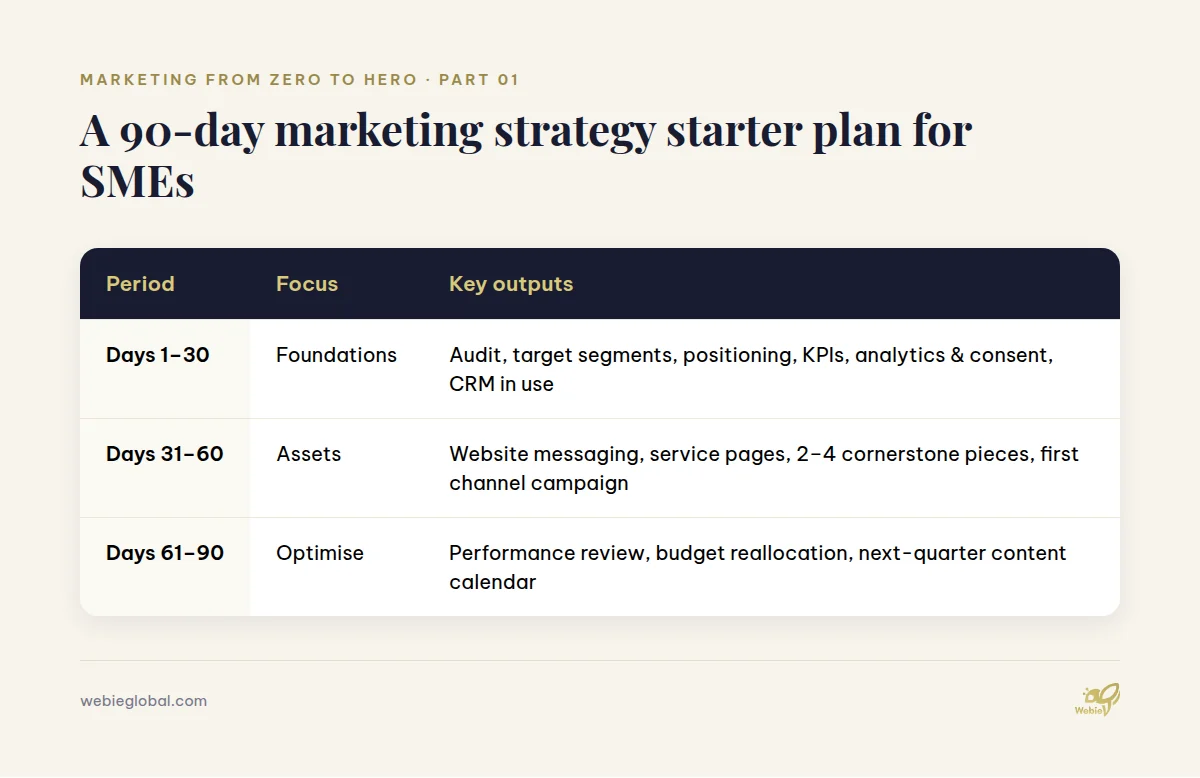
At day 90, hold a structured review: what moved the KPIs, what did not, and what you will stop doing. After that, update the marketing strategy and plan the next quarter.
Common Marketing Strategy Mistakes SMEs Should Avoid
- Starting with tactics: Launching ads or social media before defining audience and message.
- Copying large competitors: Their budgets, brand recognition and sales cycles differ from yours.
- Measuring activity instead of outcomes: Posts published and impressions are not pipeline.
- Spreading too thin: Five channels done poorly rarely beat two channels done well.
- Ignoring the website: Every other channel sends traffic there, so a weak site wastes that investment.
- No review rhythm: A marketing strategy that is never revisited quickly becomes irrelevant.
FAQ
What should a marketing strategy for SMEs include?
At minimum, it should include target customer segments, a positioning statement, measurable goals and KPIs, a prioritised channel mix, a budget and resource plan, and a review schedule. For EU markets, also include data protection and consent practices.
How long does it take to create a marketing strategy for SMEs?
A focused team can complete a first version in two to four weeks. Roughly, that means one week for the audit, one to two weeks for audience, positioning and goals, and a few days for channels and budget. After that, treat it as a living document reviewed at least quarterly.
Should an SME start with SEO or paid advertising?
It depends on urgency and demand. Paid advertising can generate leads within weeks, but it stops when spending stops. SEO, on the other hand, takes months but builds a lasting asset. As a result, many B2B SMEs combine both.
Can an SME outsource its marketing strategy?
Yes. Many SMEs work with an external partner for research, execution or specialist skills such as SEO and web development. Meanwhile, they keep ownership of goals, positioning and customer insight in-house. Clear processes, reporting and communication are what make the arrangement work.
How often should SMEs review their marketing strategy?
Review KPIs monthly, the plan quarterly and the overall strategy annually. However, review it sooner if your market, offer or target customers change significantly.
Turn Your Marketing Strategy Into Execution
A clear strategy is the first step, while consistent execution is what produces results. Webie Global supports European and international businesses with SEO, digital marketing and website development services, as well as dedicated teams. We work in English with defined processes, GDPR-aware practices and flexible engagement models, from fixed-price projects to monthly retainers.
If you would like to turn your marketing priorities into a practical roadmap, contact our team at huyen.dang@webieglobal.com.
Series navigation — Marketing from Zero to Hero: This is Part 1 of the series. Next: Defining Your Ideal Customer Profile (B2B & B2C).