


An ideal customer profile (ICP) describes the type of customer that gets the most value from your offer and, in turn, brings the most value back to your business. In practice, that means customers who are profitable, likely to stay and likely to refer others. You build it from your best existing customers rather than from assumptions. Then you use it to decide who marketing targets, which leads sales pursues and what your messaging says. This guide explains how an ICP differs in B2B and B2C, gives a six-step process and also includes a template you can fill in this week.
What Is an Ideal Customer Profile?
An ideal customer profile is a short, evidence-based description of the customers you want more of. In B2B, it describes an organisation. In B2C, by contrast, it describes a customer segment with shared needs, circumstances and behaviour.
However, an ICP is often confused with a buyer persona. The two work together, but they answer different questions. The ICP tells you which companies or segments to target, while a persona describes the people you talk to inside them.
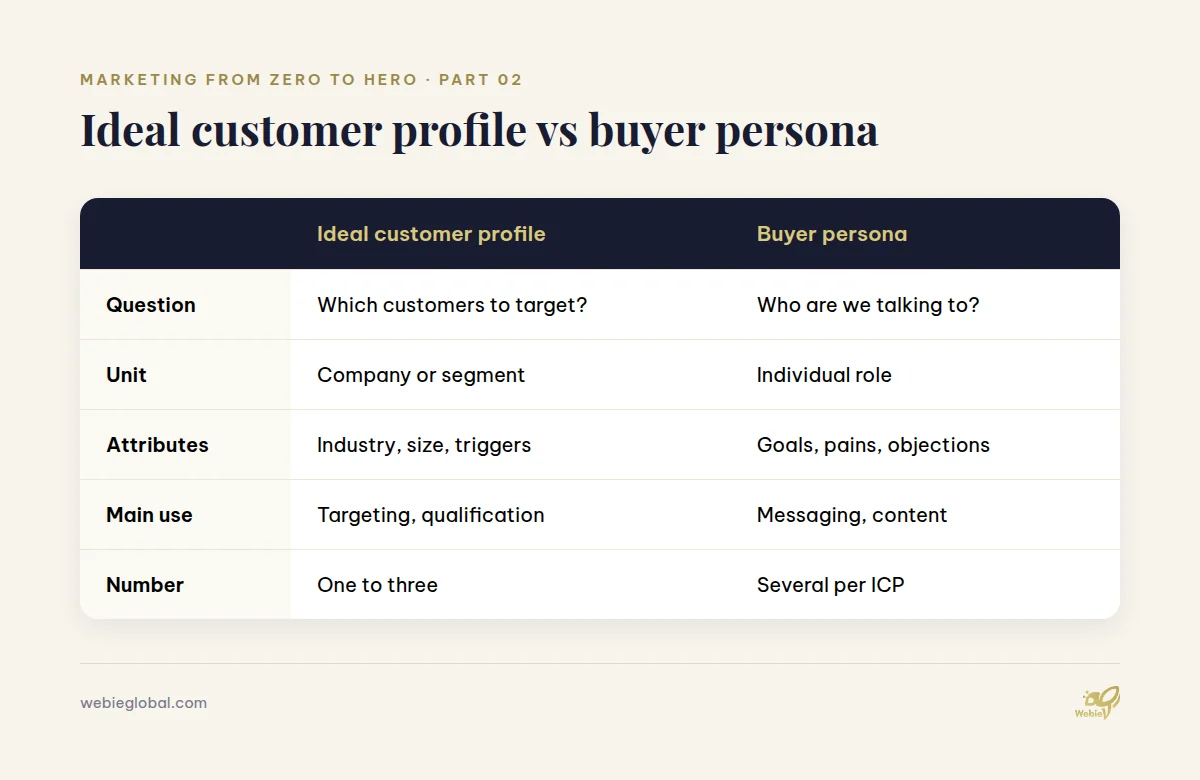
So define the ICP first. After that, build personas for the people inside, or behind, that profile.
Why an Ideal Customer Profile Matters for SMEs
Large companies can afford to test broad audiences. SMEs, on the other hand, usually cannot. For this reason, a clear ideal customer profile helps you:
- Focus budget: ads, content and events target the segments most likely to convert.
- Qualify faster: sales spends less time on leads that will never buy or will be unprofitable.
- Sharpen messaging: copy speaks to specific problems instead of generic benefits.
- Improve retention: customers who fit your offer also tend to stay longer and need less support.
- Align teams: marketing and sales finally agree on what a “good lead” looks like.
It matters even more because much of the buying process now happens before a buyer talks to you. For example, a Gartner sales survey found that 67% of B2B buyers prefer a rep-free experience. As a result, your website and content need to speak clearly to the right audience from the first visit.
How an Ideal Customer Profile Differs in B2B and B2C
The logic stays the same, because you are always looking for the customers who create the most mutual value. The inputs, however, differ.
| Dimension | B2B ICP | B2C ICP |
|---|---|---|
| Who you profile | Organisations and buying committees | Individuals or households in segments |
| Core attributes | Industry, size, region, tech stack, growth stage | Life stage, needs, location, behaviour, channel |
| Decision process | Several stakeholders, longer cycles | Often one person, shorter cycles |
| Value signal | Contract value, margin, retention | Order value, repeat purchases, referrals |
| Key data sources | CRM, sales notes, win/loss analysis | Transactions, web analytics, surveys, reviews |
If you sell to both, for example a wellness brand with a corporate programme, build separate profiles rather than one blended profile.
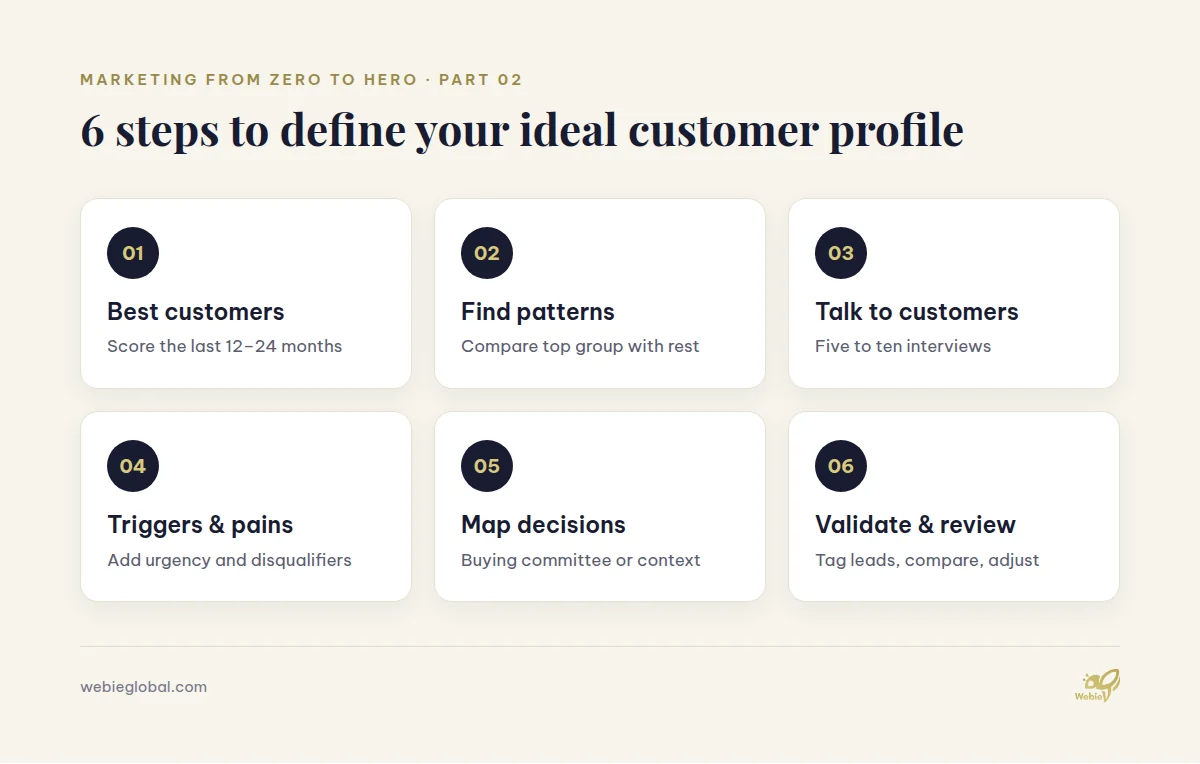
How to Define Your Ideal Customer Profile in Six Steps
Step 1: Identify your best existing customers
First, list your customers from the last 12–24 months. Then score them against a few value criteria:
- Revenue or order value, as well as gross margin after delivery effort
- Retention or repeat purchases
- Ease of working together, such as payment behaviour and support load
- Referrals, reviews or case study potential
Next, select the top 10–20% as your reference group. If you have few customers, also include strong recent opportunities and judgement from sales and delivery teams.
Step 2: Find the common patterns
Now compare the reference group with the rest. In particular, look for attributes that appear again and again:
- B2B: industry, headcount, country, revenue band, growth stage, existing tools and who initiated the purchase.
- B2C: life stage, location, purchase occasion, preferred channel, how they found you and what they bought first.
Patterns are more useful than averages. For instance, “mid-sized Dutch logistics firms that recently expanded abroad” is actionable. By contrast, “companies with 150 employees on average” is not.
Step 3: Talk to customers
Data shows what customers look like, whereas conversations show why they buy. So interview five to ten customers from the reference group, ideally including one or two recent losses. Useful questions include:
- What was happening in your business when you started looking for a solution?
- Which alternatives did you consider, including doing nothing?
- What almost stopped you from buying?
- Who else was involved in the decision?
- How do you measure whether it was worth it?
Also record the exact words customers use. In fact, they often make better headlines and ad copy than anything written internally.
Step 4: Define triggers, pains and disqualifiers
A strong ideal customer profile includes more than descriptive attributes. Therefore, add three elements:
- Trigger events: situations that create urgency, such as new funding, market expansion or a failed vendor relationship.
- Core pains: the problems your offer solves better than the alternatives.
- Disqualifiers: signals of poor fit, such as a budget below your minimum or an unrealistic timeline.
Disqualifiers are often the most valuable part, because they save sales time and protect delivery teams.
Step 5: Map the buying committee or decision context
For B2B, list the roles involved and what each one needs to see. For example, the initiator wants practical guides, while the evaluator wants documentation and data protection details. Meanwhile, the budget holder looks for clear scope and engagement models, and procurement checks contract terms.
For B2C, instead, map the decision context. That means who influences the purchase, where research happens and what reassures the buyer at checkout.
Step 6: Document, validate and review
Finally, write the ICP on one page and share it with marketing, sales and leadership. Then test it:
- Tag new leads in your CRM as ICP fit, partial fit or no fit.
- After one or two quarters, compare conversion rates, deal size and sales cycle by fit level.
- Then adjust the criteria, and review the profile at least once a year.
Ideal Customer Profile Template (B2B & B2C)
Use this template as a starting point. Above all, keep each field short and specific.
| Field | B2B prompt | B2C prompt |
|---|---|---|
| Profile name | “Scaling DACH services firm” | “Time-poor urban professional” |
| Core attributes | Industry, size, region, stage | Life stage, location, lifestyle |
| Trigger events | Expansion, funding, vendor change | Life events, seasons, new needs |
| Main pains | Top three problems, in their words | Top three frustrations, in their words |
| Decision makers | Roles and their concerns | Who influences the purchase |
| Where they research | Search, LinkedIn, events, peers | Search, social, reviews |
| Objections | Price, risk, switching effort | Price, trust, convenience |
| Disqualifiers | Signals of poor fit | Signals of poor fit |
Using Your ICP Across Marketing and Sales
An ICP only creates value when it changes day-to-day decisions. For example:
- Website: headlines and service pages address the main pains and outcomes.
- SEO and content: topics come from the questions your ideal customer profile asks at each buying stage.
- Paid campaigns: LinkedIn, Meta and Google targeting then mirrors ICP attributes.
- Lead scoring: CRM fields capture fit criteria, so leads can be prioritised automatically.
- Sales outreach: account lists are built from firmographic criteria as well as trigger events.
GDPR Considerations When Building Customer Profiles
If you process personal data of people in the EU, building customer profiles falls under the GDPR. So keep a few practical points in mind:
- Company data: firmographic data is generally not personal data, whereas details about named contacts are.
- Aggregation: use aggregated or anonymised data for pattern analysis wherever possible.
- Lawful basis: have one for analysis and targeting, and also explain it in your privacy notice.
- Consent: get informed consent for interviews and surveys.
- Tools: make sure your CRM and ad platforms are covered by data processing agreements.
The European Commission’s data protection guidance is a useful starting point. Still, this is general information, not legal advice. A later post in this series, GDPR-Compliant Marketing: What SMEs Must Know, covers the topic in more depth.
Common Ideal Customer Profile Mistakes
- Describing the whole market: an ideal customer profile that fits everyone guides nothing.
- Relying only on opinions: instead, validate assumptions with CRM data and interviews.
- Skipping disqualifiers: without them, sales still chases poor-fit leads.
- Creating too many profiles: start with one primary ICP, and add others only when you can serve them.
- Filing it away: if the ICP is not reflected in CRM fields and campaigns, then nobody is using it.
FAQ
What is the difference between an ideal customer profile and a buyer persona?
An ideal customer profile defines which companies or customer segments you should target. A buyer persona, by contrast, describes the individual people within that profile. Most businesses need both, so start with the ICP.
How many ICPs should an SME have?
Usually one to three. First, define one primary ICP that represents your most valuable customers. Then add more only when you have distinct offers and the capacity to serve each segment well.
What data do I need to build an ideal customer profile?
Start with CRM and sales data, such as revenue, margin, retention and deal cycle. Then add customer interviews, win/loss notes and web analytics.
How often should an ICP be updated?
Review it at least annually. In addition, update it whenever you launch a new offer, enter a new market or see major changes in conversion rates.
Put Your Ideal Customer Profile to Work
A well-defined ideal customer profile makes every later marketing decision easier, from website messaging to campaign targeting and CRM setup. Webie Global supports European and international businesses with SEO, digital marketing, web development and CRM solutions. We work in English with clear processes, GDPR-aware practices and flexible engagement models.
If you would like support turning your ICP into targeting, content and lead qualification, contact our team at huyen.dang@webieglobal.com.
Series navigation — Marketing from Zero to Hero: Previous: Marketing Strategy for SMEs: Where to Start · Next: Competitor Analysis Framework for European SMEs.