



Meta Ads and Google Ads are the two paid channels most European SMEs test first, and that choice shapes how fast your pipeline fills. However, the useful question is not which platform wins. Instead, it is which platform matches the demand that already exists for what you sell.
In 2024, 32.59% of EU enterprises paid to advertise on the internet, and 76.83% of them used contextual targeting tied to page content or search keywords, according to Eurostat. Search-led demand capture is therefore still the default entry point for most firms. Feed placements carry a different job.
This guide gives you a decision you can defend to your board. First, you will see what each platform really does. Then you will work through five steps, a budget split model, a fair measurement setup and the mistakes that waste the first quarter.
What Meta Ads and Google Ads actually do differently
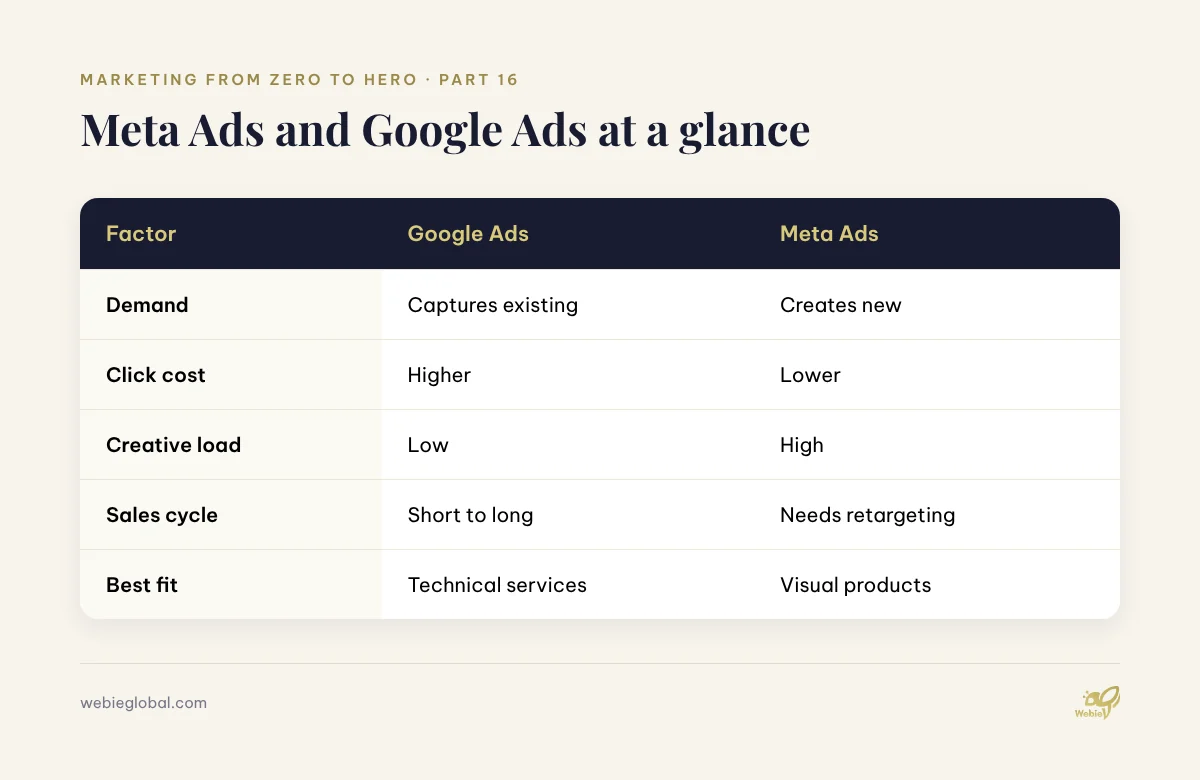
Google Ads answers demand that already exists. Someone types “nearshore development partner”, so your ad meets a buyer mid-problem. Meta Ads creates demand instead. Your ad interrupts a feed, so that person was not looking for you at all.
That single difference drives everything else. Because search demand is finite, Google Ads volume caps at the number of monthly searches for your topic. Meta Ads has almost no such ceiling. Yet it needs creative strong enough to earn a pause.
A second difference sits in what you actually buy. In Google Ads you buy keywords, match types and audiences, as the Google Ads Help guide to Search campaigns sets out. In Meta Ads you buy audiences and let the creative do most of the targeting work. As a result, Meta Ads and Google Ads reward very different skills inside a small team.
Meta Ads and Google Ads: the five factors that decide it
Five factors separate Meta Ads and Google Ads in practice. Read them as a filter, not a scorecard.
- Buying intent. Search captures intent; the feed has to create it.
- Cost per click. Feed clicks cost less, so they also convert less often.
- Creative load. Meta needs new assets monthly; search needs new keywords.
- Sales cycle. Long B2B cycles favour search plus retargeting.
- Proof. Visual products travel well in a feed; technical services rarely do.
Notice that none of these factors mention platform quality. Both systems work. Your constraints decide which one works for you first.
How to choose between Meta Ads and Google Ads in five steps
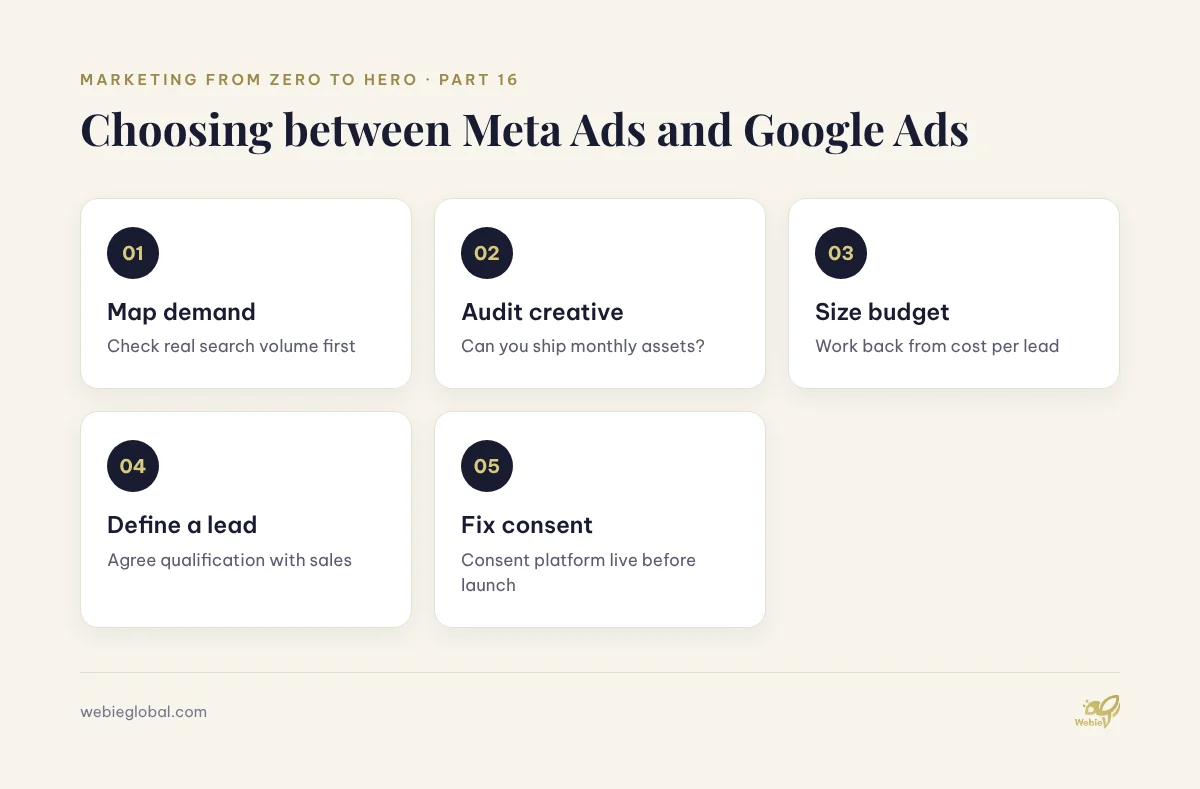
Work through these five steps in order. Each one narrows the decision, so by step five you have a channel and a budget rather than an opinion.
- Map the demand
- Audit your creative
- Size the budget
- Define a lead
- Fix consent first
Step 1 — Map the demand that already exists
Check whether people search for your category at all. Pull monthly volumes for your five core commercial terms, as covered in Keyword Research for B2B. If those terms carry real volume, start with search. If they barely register, the feed is your only route to reach buyers.
This step also protects your budget. Because a thin search market empties fast, spending there creates fake scarcity rather than leads.
Step 2 — Audit the creative you can actually produce
Meta rewards volume and variety. Therefore, ask one blunt question: can your team ship four to six new creative concepts every month? If the answer is no, Meta Ads will stall after two weeks and your cost per result will climb.
Search is kinder here. Text ads need copy, not production. For many SMEs, that practical limit settles the choice on its own.
Step 3 — Size the budget against the learning curve
Both platforms need enough conversions to optimise. A campaign that gathers only a handful of conversions a week never leaves the learning phase. So set the budget from your target cost per lead, not from what feels comfortable. Our marketing budget planning guide walks through that calculation.
Step 4 — Define what counts as a lead
Platforms optimise towards the event you send them. Consequently, a vague “form submit” goal teaches both systems to find form fillers rather than buyers. Define a qualified lead with sales first, then feed that event back. Your CRM and lead definitions should agree before a single euro goes live.
Step 5 — Fix consent and tracking before launch
In the EU, measurement depends on consent. Without a working consent management platform, conversion data arrives incomplete and both platforms optimise on noise. Our guide to GDPR-compliant marketing covers the setup. Fix this first, because retrofitting consent after launch wastes the learning data you already paid for.
When Meta Ads and Google Ads work better together
Running Meta Ads and Google Ads at the same time is not a luxury reserved for large budgets. In fact, three situations make the pair genuinely stronger than either channel alone.
First, retargeting. Search brings a visitor; the feed brings them back cheaply. Second, long consideration cycles. Buyers who research for six weeks need reminders between searches. Third, new categories. When nobody searches for your solution yet, feed campaigns create the searches that your Google Ads account later captures.
Google’s own Performance Max documentation assumes this kind of multi-surface behaviour. Still, treat combined running as a second phase. One channel, measured properly, beats two channels measured badly.
A budget split model for Meta Ads and Google Ads
The table below is the starting split we use with clients, not an industry benchmark. Adjust it once your own data arrives.
| Monthly media budget | Search share | Feed share | Reasoning |
|---|---|---|---|
| €1,000–2,000 | 100% | 0% | One channel only; learn the fundamentals |
| €2,000–5,000 | 70% | 30% | Capture demand first, then test feed creative |
| €5,000–10,000 | 55% | 45% | Prospecting and retargeting both get real data |
| Above €10,000 | 50% | 50% | Category demand deserves its own budget line |
Notice the pattern. Small budgets concentrate; larger budgets diversify. Because every split needs a target cost per acquisition behind it, set your KPIs before you divide the money, as covered in Setting Marketing Goals & KPIs.
Measuring Meta Ads and Google Ads fairly
Platform reporting flatters the platform. Meta counts a view-through as influence, while Google credits the last click. Therefore, a side-by-side read of the two dashboards will always mislead you.
Use three rules instead. First, pick one source of truth, usually your CRM, and judge both channels on qualified pipeline. Second, compare cost per qualified lead rather than cost per click. Third, run a holdout or a geo split when budgets allow, because incrementality is the only honest comparison.
A clean destination matters as much as clean data. Even perfect targeting fails on a slow page, so review your landing experience against our conversion-first design principles. The upcoming posts on Lead Generation Funnels (TOFU-MOFU-BOFU) and Conversion Rate Optimization (CRO) Playbook go deeper on that destination.
Five mistakes that waste your first quarter
- Launching both channels in week one with no measurement baseline.
- Sending platform-optimised traffic to a generic homepage.
- Judging a feed campaign on last-click attribution alone.
- Letting creative run untouched for three months.
- Starting paid media before the tracking stack works, which our marketing tech stack guide helps you avoid.
Each mistake is cheap to prevent and expensive to unwind. So audit this list before launch, not after.
FAQ
Are Meta Ads and Google Ads cheaper for B2B or B2C?
Clicks are usually cheaper in Meta Ads and more expensive in Google Ads, especially in competitive B2B categories. However, cost per qualified lead often moves the other way, because search traffic arrives with intent already formed.
Should an SME start with Meta Ads or Google Ads first?
Start where demand already exists. If your commercial keywords carry steady monthly volume, begin with search. If almost nobody searches for your category, Meta Ads and Google Ads swap places and the feed becomes your opening channel.
How much budget do Meta Ads and Google Ads need to learn?
Enough to produce a steady weekly flow of your chosen conversion event. Rather than quoting a fixed figure, work backwards: target cost per lead multiplied by the leads your sales team needs. Both Meta Ads and Google Ads then get sufficient data to optimise.
Do Meta Ads and Google Ads need consent under GDPR?
Advertising cookies and tracking pixels generally require consent in the EU. Both Meta Ads and Google Ads expect a consent signal from your consent management platform, and your own legal counsel should confirm the configuration for your markets.
Work with a team that runs Meta Ads and Google Ads properly
Choosing a channel is the easy part; staffing it is harder. Webie Global builds dedicated marketing and development teams for European SMEs, so the same team can run Meta Ads and Google Ads, fix the landing pages behind them and wire the tracking that proves results. See our services for engagement models, or email huyen.dang@webieglobal.com with your current budget and target markets. We will tell you plainly which channel we would start with and why.
Series navigation: This is Part 16 of Marketing from Zero to Hero. Previously: Google Ads for SMEs: First Campaign Setup. Next: Lead Generation Funnels (TOFU-MOFU-BOFU).