


LinkedIn marketing is the shortest path to the managing directors, operations leads and marketing heads who approve B2B budgets in Europe. However, most small and mid-sized companies still treat the platform as a noticeboard for press releases. As a result, they publish often, reach almost nobody, and then conclude that the channel does not work for them.
The channel is rarely the problem. Instead, the missing piece is a repeatable system: a sharp audience definition, a content model built for how busy buyers read, and a measurement loop that links activity to pipeline. This guide sets out that system in the order you should build it.
You will get a foundation checklist, a weekly publishing rhythm, the paid formats worth testing first, and the numbers to report each month. Everything assumes a small team and a modest budget, so nothing here depends on hiring a dedicated social media manager.
What LinkedIn marketing means for B2B decision makers
LinkedIn marketing covers three activities that only work together. First, your company page and your colleagues publish content that demonstrates expertise. Then paid campaigns put that content in front of a defined list of accounts. Finally, your sales team uses the resulting attention to open conversations.
Most teams do only the first part, so the other two never compound. Decision makers rarely respond to a single post. Instead, they notice a useful idea, check the author’s profile, read two more posts, and reply weeks later when a project lands on their desk. Therefore your goal is steady credibility over months, not one viral hit.
One distinction matters before you start. LinkedIn is a professional network rather than a shop window, so content that teaches outperforms content that sells. Eurostat’s data on social media use by enterprises shows how widely European companies have adopted these platforms, yet structured, commercial use remains far less common.
LinkedIn marketing foundations to fix before you post
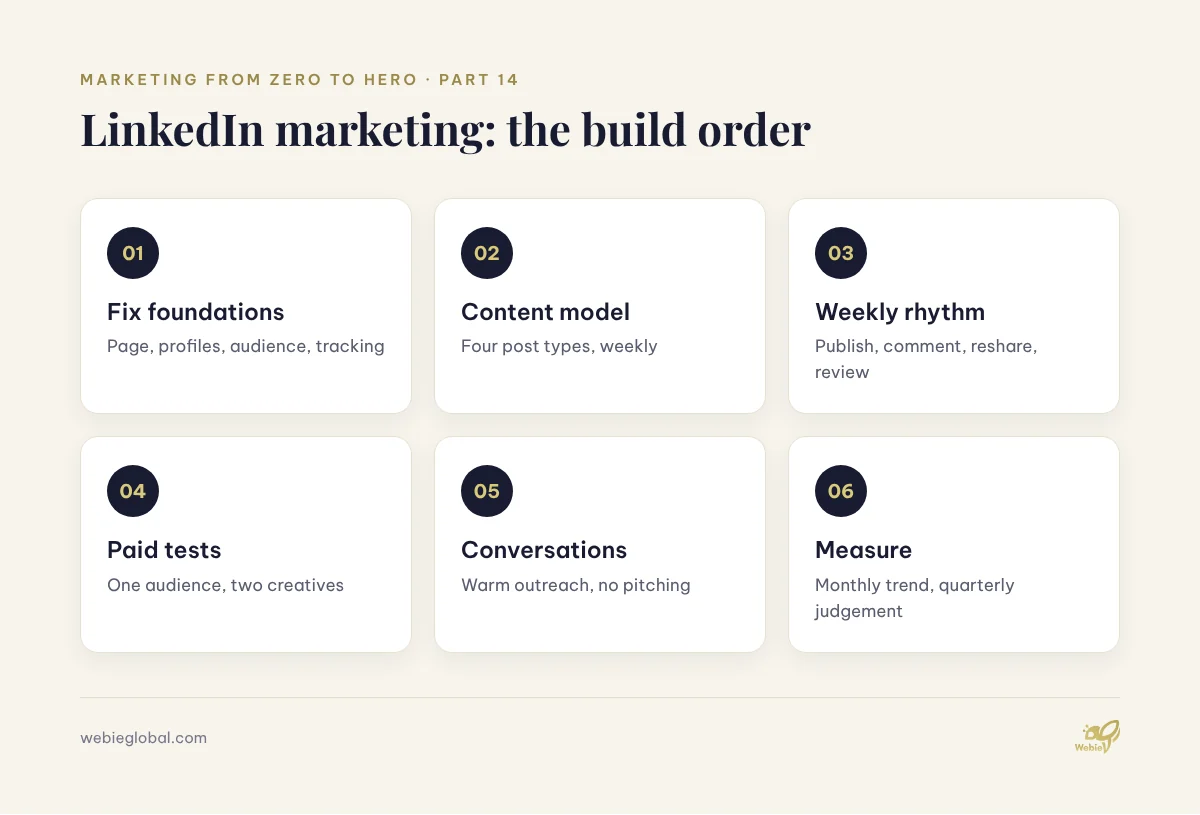
Fix four things first. Otherwise every euro you spend on reach sends attention to a profile or page that cannot convert it.
Company page essentials
Your tagline should state what you do and for whom, in plain language. In addition, the About section needs the words your buyers use rather than internal product names. Add a custom button that points to a real service page, complete the Products or Services section, and upload a cover image that still reads on a phone.
Profiles of founders and client-facing staff
People consistently out-reach pages. Therefore the three to five colleagues who speak with clients each need a headline describing the problem they solve, a banner that matches the brand, and a featured link to your offer. This takes an afternoon and costs nothing.
A written audience definition
Write down the job titles, company sizes, industries and countries you want to reach. If you have not done that work yet, start with our guide to defining your ideal customer profile. Without it, LinkedIn marketing becomes guesswork and your targeting will drift month by month.
Tracking you can trust
Install the LinkedIn Insight Tag, define conversions in your analytics, and agree internally what counts as a lead. Our post on setting marketing goals and KPIs covers those definitions. Microsoft also documents the LinkedIn Marketing API if your team later wants automated reporting.
A LinkedIn marketing content model that buyers read
Four post types cover almost everything a B2B company needs.
| Post type | Purpose | Frequency |
|---|---|---|
| Practical how-to | Prove competence | Weekly |
| Clear point of view | Build distinctiveness | Every two weeks |
| Proof: results, process, numbers | Reduce perceived risk | Monthly |
| Behind the process | Build familiarity | Monthly |
Keep posts short. Lead with the conclusion in the first two lines, because the feed truncates everything after them. Then give three to five concrete points. Finally, close with a question or one clear next step.
Documents and short native video both earn more attention than plain outbound links. For example, a one-page checklist posted as a PDF carousel usually outperforms the same checklist shared as a blog link. That said, always keep the full version on your own site so search engines can find it. Our content marketing strategy and editorial calendar guide explains how to plan both at once.
Organic LinkedIn marketing: a weekly rhythm
Organic LinkedIn marketing fails on inconsistency far more often than on content quality. A fixed weekly loop solves that, and it fits into roughly two hours.
- Monday — publish the main post from your editorial calendar.
- Tuesday to Thursday — each client-facing colleague comments on five posts from target accounts.
- Wednesday — reshare the main post with one extra thought for a different segment.
- Friday — note which posts earned profile views, then feed the winning themes back into the calendar.
Comments deserve particular attention. Because replies signal relevance, a post with twelve real conversations in the comments usually travels further than one with a hundred passive likes. So answer every comment on the day it arrives.
Paid LinkedIn marketing: formats and targeting
Organic reach alone rarely fills a B2B pipeline. Paid LinkedIn marketing costs more per click than search advertising, so buy precision instead of volume.
Formats worth testing first
Single-image Sponsored Content is the sensible starting point, and LinkedIn’s own help pages describe the available ad formats and their specifications. Document ads suit checklists and frameworks. Message ads suit warm, narrow lists, although they irritate cold audiences, so use them sparingly. Lead gen forms lift conversion rates because fields pre-fill, but the leads then need a same-day follow-up to stay useful.
Targeting without wasting budget
Start with one audience of roughly 30,000 to 300,000 people. Combine job function and seniority with company size and country, then exclude your own employees and current clients. Avoid stacking too many filters, because a very small audience pushes costs up quickly. Also switch off audience expansion and the Audience Network during your first tests, so the data stays readable.
Budget discipline matters just as much. Run two creatives per audience for at least two weeks before judging either of them, and keep the landing page consistent with the ad. Our marketing budget planning guide shows how to size a test budget without distorting the rest of your plan. If search intent suits your offer better, the next article in this series, Google Ads for SMEs: First Campaign Setup, covers that route instead.
Turning attention into conversations
Content creates attention, while conversations create pipeline. Give your sales colleagues a simple routine: review who viewed their profile, open a short note referencing something specific, and never pitch in the first message.
A connection request with two sentences of context beats a blank one. In addition, a comment left on a prospect’s post three weeks before any outreach makes the eventual message far less cold. Then, when the conversation becomes a real opportunity, log it in your CRM so attribution survives the handover.
Measuring LinkedIn marketing performance
Report a small, stable set of numbers every month.
- Impressions and engagement rate, as a sanity check on reach
- Profile and company page views, which show rising interest
- Clicks through to your service pages
- Inbound conversations started by the team
- Qualified leads and pipeline value attributed to the channel
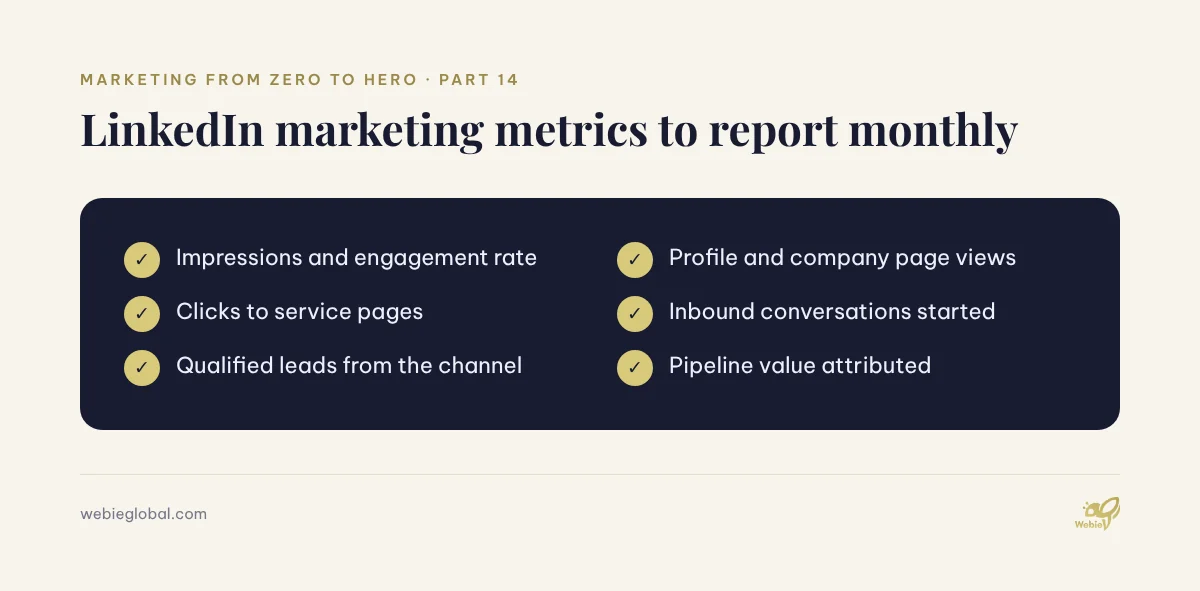
Read these as a trend across quarters rather than week to week. B2B buying cycles run long, so one flat month means very little on its own.
GDPR and LinkedIn marketing
Consent and lawful basis still apply when a lead arrives through a pre-filled form. Therefore record where the data came from, state your purpose at the point of collection, and apply the same retention rules you use everywhere else. Our GDPR-compliant marketing guide covers the detail for European SMEs.
Common LinkedIn marketing mistakes
- Posting only company news, which reads as advertising
- Polishing the company page while personal profiles stay empty
- Swapping creatives every few days, so no test ever finishes
- Buying follower campaigns instead of reaching actual buyers
- Treating comments as optional, although replies drive most of the reach
FAQ
How much budget does LinkedIn marketing need?
Treat your first three months as a learning budget rather than a performance one. Run one audience and two creatives, then keep spending only where cost per qualified conversation looks sustainable against your average deal size. Organic activity continues in parallel and costs only time.
Is LinkedIn marketing GDPR-compliant by default?
No. The platform gives you compliant tools, yet your own lawful basis, notices and retention rules remain your responsibility. So document them before you launch any lead generation campaign.
How long before LinkedIn marketing produces leads?
Expect three to six months before the channel produces predictable inbound conversations. Profile views and comment quality improve much sooner, and both are useful early signals.
Should the founder post, or the company page?
Both, with different jobs. Founders and specialists carry the opinions and the reach, while the page carries proof, services and recruitment. Reposting page content from personal profiles connects the two.
Does LinkedIn marketing work for non-English European markets?
Yes, although language choices matter. Publish in the language your buyers work in, and keep your site aligned with that decision. Our guide to local and multi-language SEO in Europe explains how to keep both consistent.
Build your LinkedIn marketing engine with Webie Global
If your team lacks the capacity to run this consistently, we can run it with you. Our services cover content, paid campaigns, tracking and the development work behind the landing pages that convert. We work with European SMEs as a dedicated extension of their team, with clear processes and flexible engagement models.
To discuss your LinkedIn marketing plan, email huyen.dang@webieglobal.com and we will review your current setup first.
Series navigation: Previous — Local & Multi-Language SEO in Europe. Next — Google Ads for SMEs: First Campaign Setup. Part 14 of Marketing from Zero to Hero.