



A competitor analysis framework is a repeatable way to identify who you really compete with, compare them on the criteria your buyers use and then turn the findings into decisions. For most European SMEs, a practical version takes two to three weeks. It also relies on public information and customer conversations, so it fits into one shared spreadsheet. This guide therefore gives you a six-step process, a scoring template and the legal boundaries to respect under EU rules.
In the first post of this series, we set out the core decisions behind a marketing strategy. Then, in the second, we defined the ideal customer profile. Competitor analysis connects the two, because once you know who you serve, you need to know which alternatives those customers weigh against you.
Why a Competitor Analysis Framework Matters for SMEs
Large companies can win on brand recognition and budget. SMEs, however, usually win on focus: a sharper niche, faster response or deeper expertise. Still, you can only claim that ground deliberately when you know where competitors are strong, vague or absent.
A structured competitor analysis framework helps you in five ways:
- Avoid me-too messaging: if your headline could sit on three competitor sites unchanged, buyers have no reason to shortlist you.
- Price with context: you do not need to be the cheapest, but you do need to know what buyers compare you against.
- Find content gaps: questions competitors answer poorly then become opportunities for your content.
- Prepare sales: knowing objections such as “Why not just use X?” lets you answer them early.
- Spot market shifts: new entrants and changing offers often show up in competitor behaviour first.
European markets also add complexity. For example, a German or Dutch buyer may compare you with local specialists, pan-European providers and international players at the same time. A framework keeps that comparison consistent.
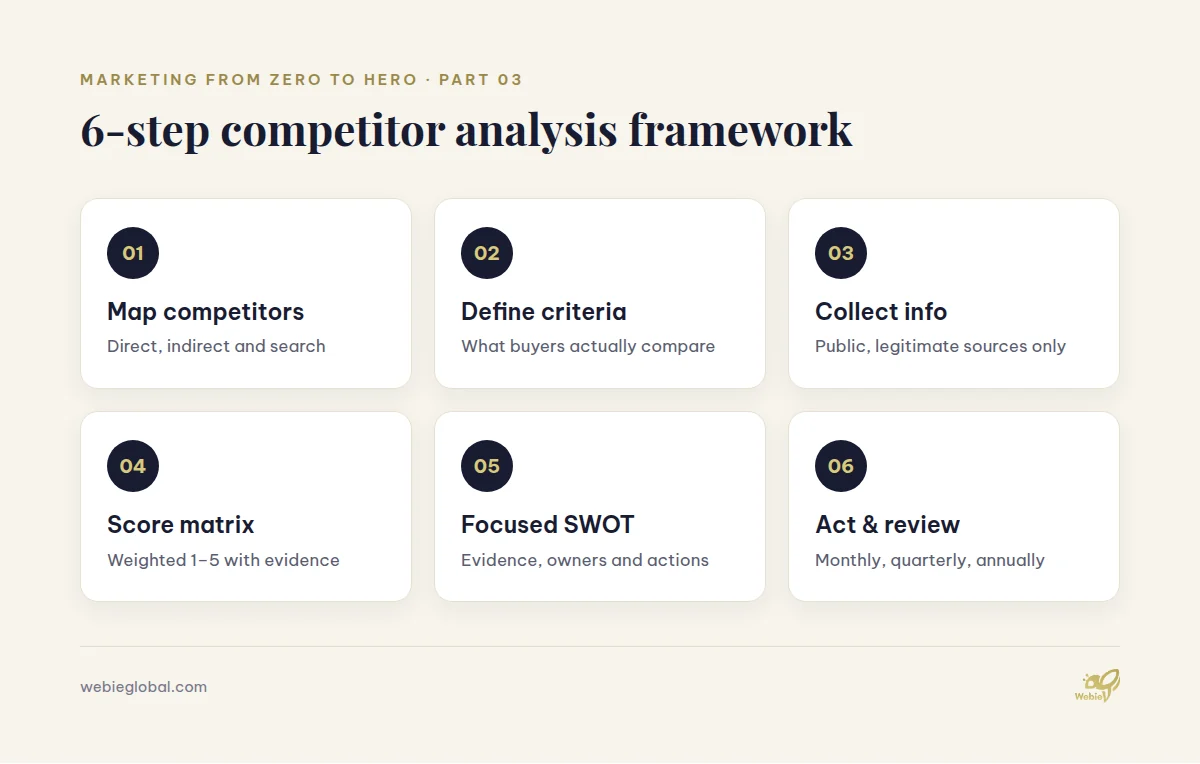
Step 1: Map Your Real Competitors
Most SMEs underestimate their competitive set. So list competitors in three groups:
| Type | Definition | Where to find them |
|---|---|---|
| Direct | Similar solution, same customer segment | Lost deals, prospect shortlists, directories |
| Indirect | Same problem, different approach | In-house teams, freelancers, software tools |
| Search | Rank for your buyers’ queries | Google results in each country and language |
In addition, do not forget the most common B2B alternative: doing nothing. It rarely appears in a spreadsheet, yet it often wins.
A few practical tips help here:
- First, ask sales which names came up in the last 10–20 opportunities, won and lost.
- Then search your main service terms in each market’s language, for example German for DACH.
- Also check review platforms, trade association lists and event exhibitor lists.
Finally, narrow the list to five to eight competitors. That usually means the three or four you meet most in deals, plus one or two indirect and search competitors.
Step 2: Define the Criteria That Matter to Buyers
The most common mistake is comparing what is easy to see, such as logos or social posts, instead of what drives decisions. Instead, start from your ideal customer profile and ask what buyers actually compare. Typical criteria for European B2B services include:
- Offer and specialisation: services, industries served and niche focus.
- Proof: case studies, references and certifications.
- Commercial model: pricing transparency as well as fixed-price, retainer or time-and-materials options.
- Delivery and process: onboarding, project management, language and time-zone coverage.
- Trust and compliance: GDPR information, data processing agreements and security statements.
- Digital visibility: organic search presence, LinkedIn activity and content quality.
Limit yourself to eight to ten criteria. Then write a one-line definition for each, so that team members score consistently.
Step 3: Collect Information From Legitimate Sources
Fortunately, you can learn a great deal from public sources:
- Websites: service pages, pricing, case studies and careers pages, since hiring shows where a company invests.
- Search results: the topics they rank for in each market. SEO tools speed this up, although a manual review of your top 20 buyer queries is a solid start.
- LinkedIn: company updates, employee growth and thought-leadership themes.
- Review platforms: what clients praise and what they criticise.
- Company registers: many EU countries also publish basic financial filings.
- Your own customers: above all, ask why they chose you and who else they considered.
Where to draw the line
Competitive intelligence must stay within legal and ethical limits. Therefore, never misrepresent yourself or seek confidential information from a competitor’s staff. EU law protects that kind of know-how, as the EU rules on trade secrets explain. Similarly, information about named individuals is personal data under the GDPR, so keep your analysis focused on companies. If you later publish comparisons, also respect the EU rules on comparative advertising. This is general guidance, not legal advice.
Step 4: Score Competitors in a Simple Matrix
Next, put your findings into one comparison matrix. Score each competitor, and yourself, from 1 (weak) to 5 (strong). Also add a short evidence note, so scores can be challenged.
| Criterion | Weight | You | Comp. A | Comp. B |
|---|---|---|---|---|
| Specialisation in target industry | 20% | |||
| Proof (case studies, references) | 20% | |||
| Pricing and engagement flexibility | 15% | |||
| Process and communication | 15% | |||
| GDPR and security information | 10% | |||
| Local language and market presence | 10% | |||
| Organic search visibility | 10% |
A few rules keep the matrix honest:
- Weight criteria by buyer importance, because what flatters you rarely predicts a sale.
- Score yourself as a buyer would, based only on what is visible from the outside.
- Record evidence, such as a URL or a deal note, for every score of 1 or 5.
- Have two people score independently, and then discuss the differences.
In the end, patterns matter more than totals. Criteria where everyone scores high are table stakes, whereas criteria where everyone scores low are potential differentiators.
Step 5: Turn Findings Into a Focused SWOT
A SWOT is only useful when it rests on the evidence from your matrix rather than on assumptions. So keep each quadrant to three to five points:
- Strengths: criteria where you clearly lead and buyers care.
- Weaknesses: gaps buyers notice, for instance missing case studies or no content in a target language.
- Opportunities: criteria where all competitors are weak, as well as unanswered buyer questions in search.
- Threats: well-funded entrants, price pressure or competitors moving into your niche.
Then ask one question for each point: what will we do about it next quarter? After all, a SWOT without owners and actions is only a description.
Step 6: Act on the Analysis and Keep It Current
Now translate the findings into decisions. For example, emphasise a differentiator competitors lack in your positioning. Similarly, add proof to your website where you score low. For SEO, target buyer questions that competitors cover poorly, in each priority language. Meanwhile, give sales short battlecards that explain when you win, when you lose and how to handle objections.
Because competitive landscapes change, set a simple rhythm:
- Monthly: a 15-minute check of competitor websites and new names in deals.
- Quarterly: update scores and battlecards with sales feedback.
- Annually: run a full review alongside your marketing strategy, or sooner if you enter a new market.
The next post in this series, Positioning & Value Proposition That Converts, then shows how to turn these insights into a clear message.
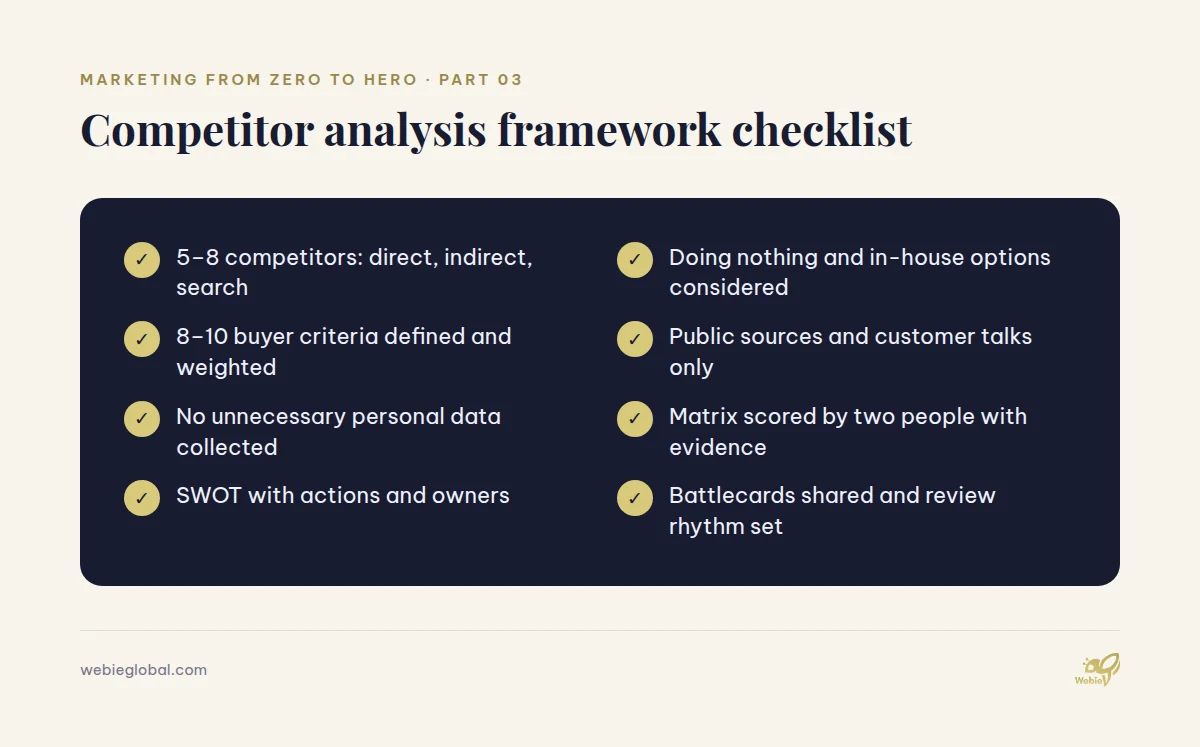
Competitor Analysis Framework Checklist
Before you share the results, check that your competitor analysis framework covers every point below.
Common Competitor Analysis Framework Mistakes
- Only analysing the biggest names: in fact, the competitors you meet in deals are often smaller and more local.
- Copying competitors: instead, use the analysis to find where to be different.
- Ignoring language markets: a competitor invisible in English search may still dominate German results.
- Treating it as a one-off: a two-year-old spreadsheet can lead to wrong decisions today.
- Keeping it in marketing: if sales and leadership never use the findings, then the effort is wasted.
FAQ
What is a competitor analysis framework?
A competitor analysis framework is a structured, repeatable process for identifying competitors and comparing them on buyer-relevant criteria. It then turns the results into decisions on positioning, content, pricing and sales. Typically, it combines a competitor map, a scoring matrix and an evidence-based SWOT.
How many competitors should an SME analyse?
Five to eight is practical for detailed work. That includes the competitors you meet most in deals, plus one or two indirect and search alternatives. Meanwhile, you can monitor a longer list more lightly.
How often should you update your competitor analysis framework?
Run light monitoring monthly and update scores quarterly. In addition, complete a full review once a year or whenever you enter a new market.
Is competitor research legal under the GDPR?
Analysing public information about companies is common practice. However, take care with data about identifiable individuals, and never use deception. For specific situations, consult a data protection professional.
Turn Your Competitor Analysis Framework Into Market Advantage
Knowing where competitors leave gaps is only valuable when it shapes your website, content and campaigns. Webie Global supports European and international businesses with SEO and digital marketing, conversion-focused web development and dedicated teams. We work in English with clear processes, GDPR-aware practices and flexible engagement models. See our full range of services.
If you would like a second perspective on your competitive landscape, contact our team at huyen.dang@webieglobal.com.
Series navigation — Marketing from Zero to Hero: Previous: Defining Your Ideal Customer Profile (B2B & B2C) · Next: Positioning & Value Proposition That Converts.