




B2B keyword research decides which pages you build, which buyers find them, and how much of your content budget earns a return. Yet most SME teams start from a tool, export two thousand rows, and then stall. The list looks impressive. However, it rarely maps to anything the sales team recognises.
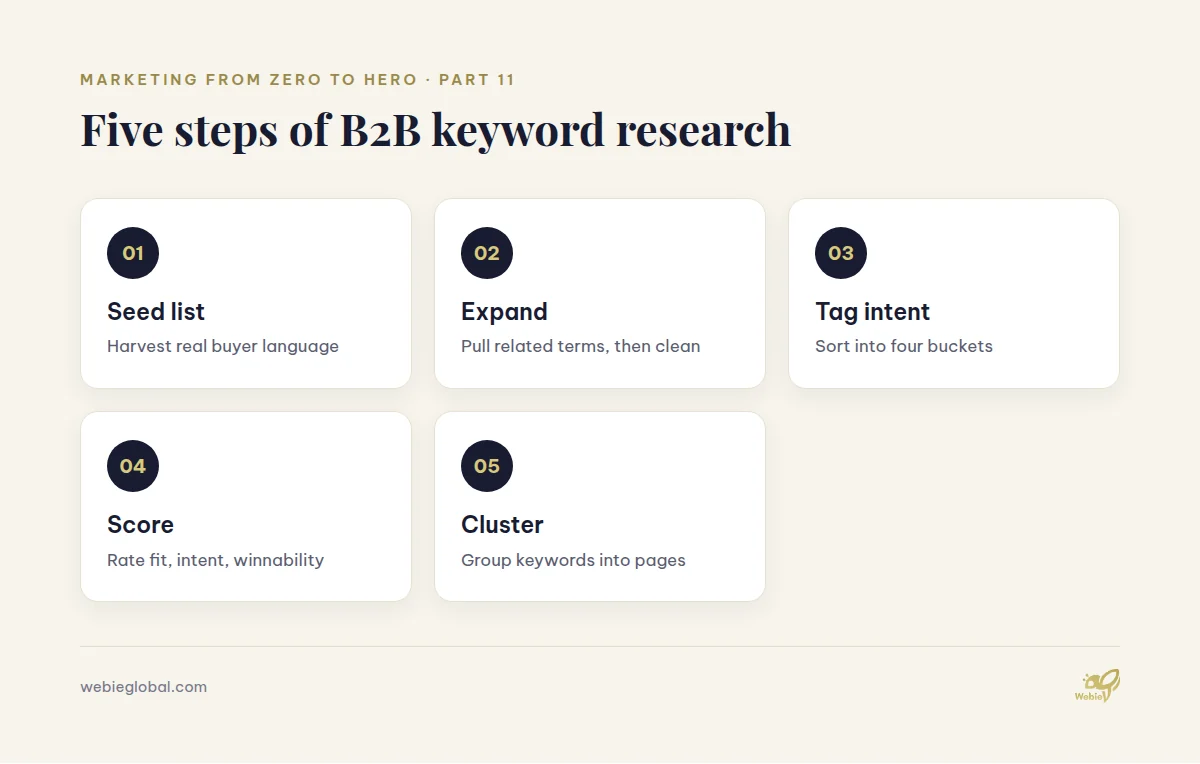
This guide walks through a five-step process you can run in a single afternoon. First you gather seed terms from the language buyers already use. Then you expand, score and cluster them into pages. Along the way you will see why volume matters less in B2B than in consumer search, and what to trust instead.
What makes B2B keyword research different
In consumer search, one person decides and buys. In B2B, a buying group decides: a managing director, a marketing lead, an IT manager, often a procurement officer too. Each role searches differently. Therefore B2B keyword research has to cover several vocabularies for the same underlying problem.
Volumes are also small. A term with ninety searches a month can be worth more than one with nine thousand, because the ninety are in-market buyers and the nine thousand are students. As a result, the habit of sorting by volume actively misleads you.
Finally, the cycle is long. Buyers read for weeks before they contact anyone. So your keyword set needs pages for early questions as well as late-stage comparisons.
| Factor | Consumer search | B2B search |
|---|---|---|
| Who decides | One person | Three to six people |
| Typical volume | High | Low to very low |
| Cycle length | Minutes to days | Weeks to months |
| Success signal | Traffic | Qualified pipeline |
Four inputs that make B2B keyword research faster
Before you open a tool, collect four things. This takes twenty minutes, and it saves hours later.
- Your ideal customer profile. Who you serve, in which countries, at what company size. Our guide to defining your ideal customer profile covers the format.
- Your positioning. The words you want to own, from your value proposition.
- Real questions. Twenty of them, pulled from sales calls, support tickets and your inbox.
- Two or three competitors you actually lose deals to, ideally from a competitor analysis.
Without the profile, B2B keyword research drifts toward whatever has the biggest numbers. With it, you can reject half the list in minutes.
Step 1 — Build a seed list from real language
Seeds are the fifteen to thirty short phrases your whole set grows from. Do not invent them at a whiteboard. Instead, harvest them.
Mine the words your buyers already use
Start with your own records. Read the last twenty inbound enquiries and note the nouns people use for your service. For example, a company selling development capacity will see “offshore developers”, “nearshore team”, “staff augmentation” and “hire remote developers” — four vocabularies for one offer.
Then check three more sources: your Search Console queries, the lost-reason notes in your CRM, and the subject lines of sales emails. Each source hands you phrasing you would never have guessed.
Borrow from competitors and from the SERP
Next, open a competitor’s service pages and copy their H1s and navigation labels. Also read what Google suggests. Autocomplete, “People also ask” and “Related searches” are free demand signals, and they come straight from the source.
Google’s guidance on creating helpful, people-first content is a useful filter at this stage. If a keyword cannot support a page that genuinely helps someone, drop it now rather than later.
Step 2 — Expand seeds into a working set
Now expand each seed. Pull related terms, questions and phrase matches, then combine everything into one sheet. Google’s free Keyword Planner is enough to start; paid tools add difficulty scores and competitor gaps.
Aim for roughly 150 to 400 rows, not thousands. Then clean the set hard:
- Remove terms tied to countries you do not serve.
- Remove job-seeker queries such as “developer salary” or “remote jobs”.
- Remove definition and student queries, unless you want deliberate top-of-funnel reach.
- Merge near-duplicates, and keep the form people actually type.
This pass usually deletes 40 to 60 percent of the export. Because what remains is relevant, every later step runs faster.
Step 3 — Judge intent before volume
Volume tells you how many people search. Intent tells you who they are. In B2B keyword research, intent is by far the more valuable signal of the two.
An intent map for B2B keyword research
Sort every surviving keyword into one of four buckets.
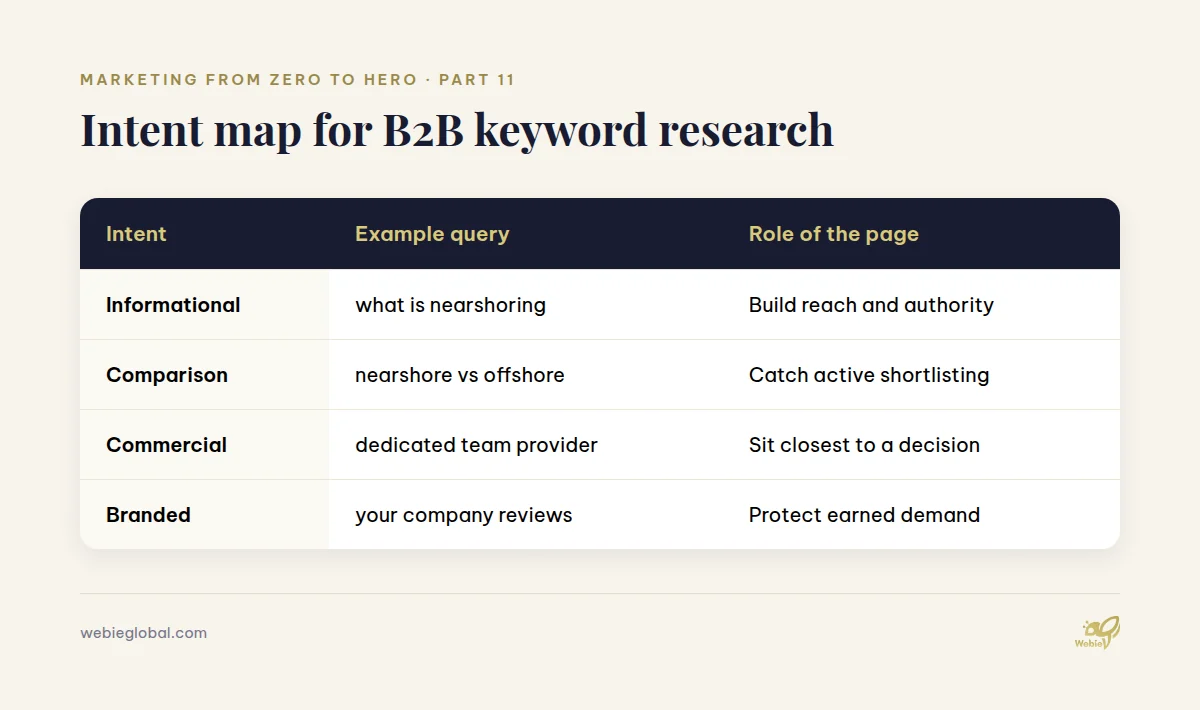
Informational terms (“what is nearshoring”) build reach and authority. Comparison terms (“nearshore vs offshore development”) catch buyers already shortlisting. Commercial terms (“dedicated development team provider”) sit closest to a decision. Branded terms protect what you have already earned.
A balanced set leans commercial and comparative. For a first content plan, roughly half your pages should target those two buckets, because they convert fastest. The rest can serve earlier stages and build topical depth over time.
Step 4 — Score and prioritise
A scoring model for B2B keyword research
Score every keyword from one to three on four factors, then add the scores up. This keeps B2B keyword research honest, because it forces a trade-off instead of a wish list.
| Factor | Score 1 | Score 2 | Score 3 |
|---|---|---|---|
| Buyer fit | Wrong audience | Adjacent | Exactly our ICP |
| Intent | Informational | Comparison | Commercial |
| Winnability | Enterprise pages rank | Mixed SERP | Peers of our size rank |
| Business value | Nice to have | Supports a service | Maps to a revenue line |
Anything scoring ten or more goes into your first wave. Scores of seven to nine form the second wave. Everything below seven waits, and some of it never ships at all. That is a healthy outcome, not a failure.
Step 5 — Cluster keywords into pages
One keyword does not equal one page. Instead, group keywords that share an intent and would be answered by the same article.
A practical cluster has one primary keyword, three to six secondary variants, and a clear page type. For example:
- Primary: nearshore software development
- Secondary: nearshore vs offshore, nearshore development costs, nearshore team setup
- Page type: service page, with a comparison section
Then assign each cluster to a month and an owner. Your marketing tech stack can hold this as a simple board, and your technical SEO basics decide whether those pages can be crawled at all. The next post in this series, Content Marketing Strategy & Editorial Calendar, turns these clusters into a publishing schedule.
Common B2B keyword research mistakes
Five patterns cause most of the damage. Watch for them in your own sheet.
- Chasing volume. High-volume head terms bring the wrong visitors and almost never convert.
- Ignoring the SERP. If the first page is all directories and enterprise vendors, ranking will take years.
- One keyword per page. This produces thin, overlapping articles that compete with each other.
- Skipping the sales team. They already know the phrases buyers use on calls.
- Treating it as a one-off. Markets move, so a keyword set from last year is a starting point, not a plan.
A 90-minute B2B keyword research sprint
Short on time? Run this instead of postponing the work again.
| Minutes | Task |
|---|---|
| 0–15 | Gather your ICP, positioning and twenty real questions |
| 15–30 | Write 20 seeds from enquiries, CRM notes and competitor pages |
| 30–55 | Expand seeds in a keyword tool, then export |
| 55–70 | Clean the set and tag intent |
| 70–85 | Score and sort, then pick the top ten |
| 85–90 | Group the top ten into three clusters and assign owners |
The output is small on purpose. Three solid clusters beat a spreadsheet nobody opens.
FAQ
How many keywords does B2B keyword research actually need?
Fewer than you think. A focused set of 60 to 120 scored keywords, grouped into eight or ten clusters, will keep an SME content team busy for two quarters. Depth beats breadth here.
Is search volume reliable for B2B keyword research?
Treat it as a rough signal only. Tool volumes are estimates, and they round small numbers heavily, so a “10 per month” term may well see more. Therefore judge intent and buyer fit first, and use volume to break ties.
Which tools do I need to start?
A spreadsheet, Google Search Console and Keyword Planner cover the basics at no cost. Paid platforms help once you need difficulty scores, competitor gap analysis and tracked rankings across several European markets.
How often should B2B keyword research be refreshed?
Review your clusters once a quarter, and rebuild the set once a year. In addition, add new seeds whenever sales reports a phrase you have not seen before, because that is usually demand arriving early.
Get your keyword plan reviewed
Keyword work pays off only when it reaches production: pages written, published and measured. If your list has been sitting in a spreadsheet for months, our team can turn it into a plan with owners and dates. Explore our services or email huyen.dang@webieglobal.com for a short review of your current set.
Series navigation: this is part 11 of Marketing from Zero to Hero. Previously: Technical SEO Basics for Business Websites. Next: Content Marketing Strategy & Editorial Calendar.