





Setting marketing goals and KPIs means turning your business objectives into a few clear targets, then choosing the metrics that show whether you are on track. For most SMEs, the best approach combines both frameworks. SMART goals work well for fixed, operational targets, while OKRs suit ambitious quarterly priorities that need focus across a team. In practice, you might use one OKR per quarter for growth and SMART goals for channel work. This guide explains both frameworks, compares them and then gives you a five-step process with KPI examples.
So far, this series has covered your marketing strategy, your ideal customer profile, a competitor analysis framework and your value proposition. Goals now make that work measurable.
Why Marketing Goals and KPIs Matter for SMEs
Without clear targets, marketing quickly becomes a list of activities. For example, a team posts on LinkedIn, runs a few ads and publishes blog articles, yet nobody can say whether any of it helped sales. As a result, budgets get cut first when times are tight.
Well-defined marketing goals and KPIs change that in four ways:
- Focus: a small team works on the few things that move revenue, instead of everything at once.
- Budget decisions: you can shift spend towards channels that deliver, because you see the numbers.
- Alignment: marketing, sales and leadership also agree on what success looks like.
- Learning: when a target is missed, you know early and can then adjust.
For SMEs, this matters even more, since there is rarely room for large experiments without a clear link to results.
Goals, Objectives, KPIs and Metrics: Clear Definitions
These terms often get mixed up. So it helps to agree on definitions before you set anything:
- Business objective: the result the company needs, for example more revenue from a new market.
- Marketing goal: marketing’s contribution to that objective, such as more qualified leads from Germany.
- KPI (key performance indicator): the few numbers that show progress on the goal, for instance sales-qualified leads per month.
- Metric: any measurable number, such as page views or email open rates. Every KPI is a metric, but most metrics are not KPIs.
In other words, a metric becomes a KPI only when it is tied to a goal and someone acts on it.
What Are SMART Goals?
SMART is a checklist for writing goals that can be tracked. The idea is usually traced to George T. Doran, who described it in Management Review in 1981. Today, the letters are commonly read as:
- Specific: clear about what should change.
- Measurable: tied to a number you can track.
- Achievable: realistic with your team and budget.
- Relevant: connected to a business objective.
- Time-bound: with a deadline.
For example, “increase marketing-sourced sales-qualified leads from DACH from 10 to 15 per month by 31 March” is a SMART goal. By contrast, “grow our presence in Germany” is not, because nobody can tell when it is done.
SMART goals therefore work best for targets you expect to hit, such as reporting deadlines, campaign launches or steady lead volume.
What Are OKRs?
OKR stands for objectives and key results. An objective describes what you want to achieve in qualitative, motivating terms. Key results, meanwhile, are two to five measurable outcomes that show whether you got there.
Google’s re:Work guide to OKRs explains that objectives should be ambitious and that key results should be measurable. It also notes that Google does not expect every key result to be fully achieved. Instead, stretch targets are meant to push teams beyond what feels safe.
For instance, a quarterly marketing OKR might look like this:
- Objective: become a recognised option for mid-sized PropTech firms in the Netherlands.
- Key result 1: win 8 sales-qualified leads from Dutch PropTech companies.
- Key result 2: rank on page one for three priority buyer queries.
- Key result 3: publish two case-based articles and get 400 downloads of a guide.
OKRs are usually set quarterly, reviewed weekly and scored at the end of the cycle.
OKR vs SMART: Which Framework Fits Your Marketing Goals and KPIs?
Both frameworks are useful, but they solve different problems. SMART makes a single goal clear, whereas OKRs connect a team around a few ambitious priorities.
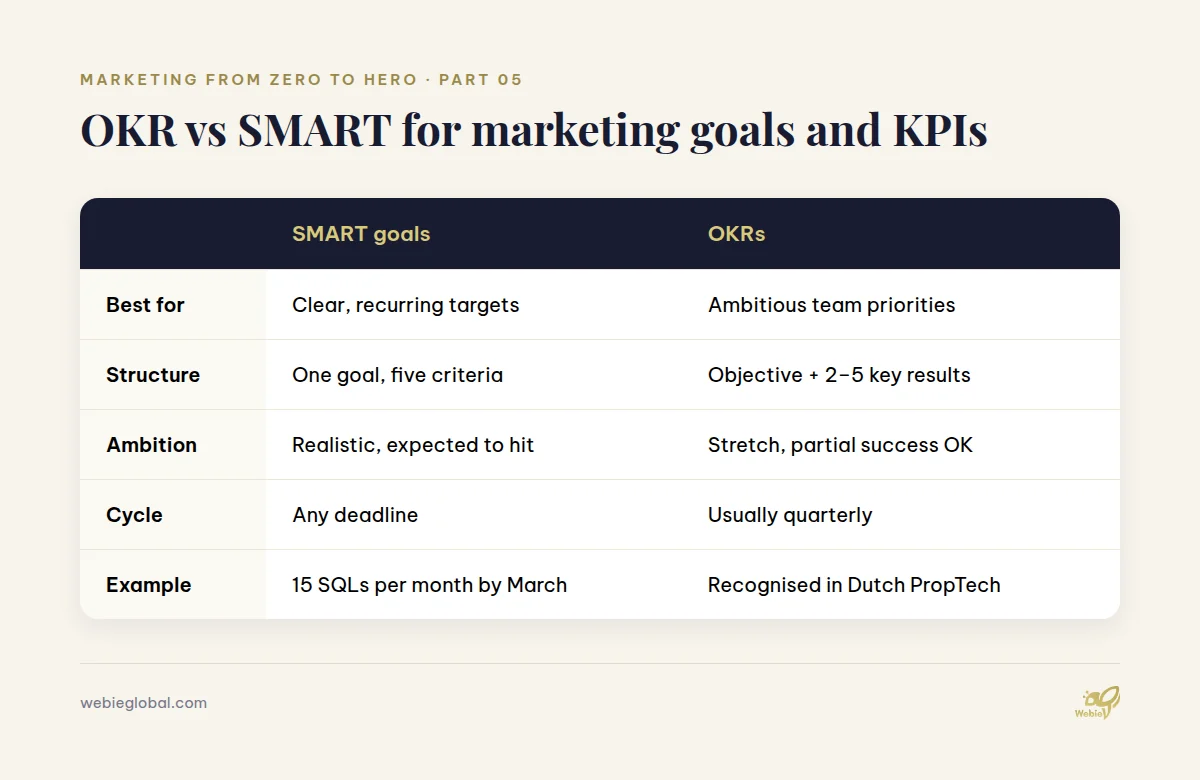
In practice, you do not need to choose one. Many SMEs set one or two OKRs per quarter for growth priorities. Then they use SMART goals for recurring channel work, such as monthly email or paid search targets. However, keep the total small, because five objectives for a three-person team is no longer focus.
How to Set Marketing Goals and KPIs in Five Steps
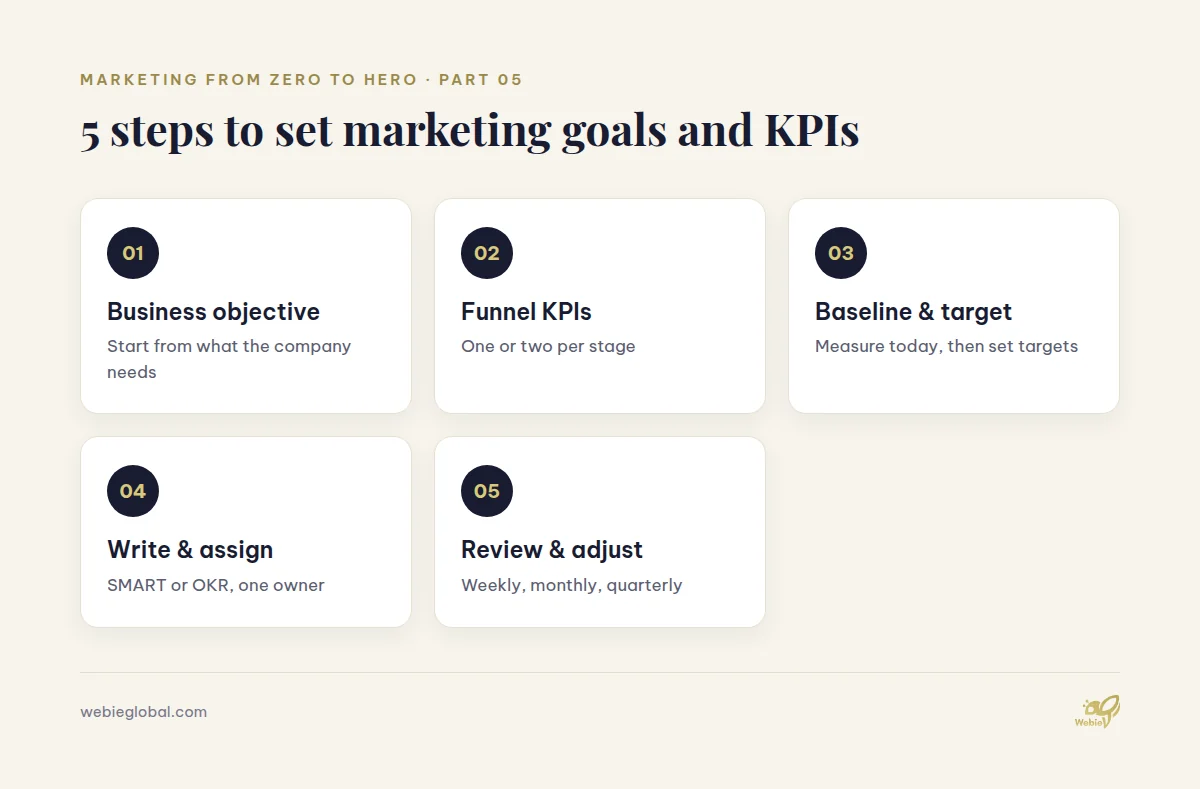
Step 1: Start from the business objective
First, ask leadership what the business needs in the next 12 months. That could be revenue from a new market, more recurring contracts or less dependence on one client. Then write down marketing’s role in it. For example, if sales closes one in four qualified leads, a revenue target already tells you roughly how many leads you need.
Step 2: Map the funnel and choose KPIs per stage
Next, pick one or two KPIs for each funnel stage rather than tracking everything:
| Funnel stage | Example KPIs | Typical source |
|---|---|---|
| Awareness | Organic sessions from target countries, branded searches | GA4, Search Console |
| Consideration | Guide downloads, returning visitors, webinar sign-ups | GA4, marketing automation |
| Conversion | Marketing-qualified and sales-qualified leads | CRM |
| Revenue | Pipeline value, customer acquisition cost | CRM, finance |
| Retention | Renewal or repeat purchase rate | CRM, billing |
Also make sure the data exists. In GA4, for instance, you need to mark the right events as key events before you can report on them.
Step 3: Set a baseline and a realistic target
Before you pick a number, measure where you are today. If you have no data yet, then spend the first month collecting a baseline. After that, set targets based on past performance, capacity and budget. For SMART goals, aim for targets you expect to reach. For OKR key results, on the other hand, a stretch is acceptable.
Here is a simple illustration. Suppose your website currently generates 40 enquiries per quarter, and sales rates about a quarter of them as qualified. A SMART goal of 12 qualified leads next quarter is then realistic. By contrast, an OKR key result of 18 would be a stretch, so it only makes sense if you also plan new activity, such as a campaign in a new market. Either way, the baseline keeps the conversation grounded in numbers rather than hopes.
Step 4: Write the goals and assign owners
Now write each goal in SMART form or as an OKR. In addition, give every goal or key result one owner. Shared ownership sounds fair, yet it often means nobody follows up.
Step 5: Review, report and adjust
Finally, set a rhythm. Check leading KPIs weekly, report to leadership monthly and review goals quarterly. When a KPI moves in the wrong direction, look for the cause before changing the target. Also note what you learned, because it will improve next quarter’s goals.
Marketing Goals and KPIs Checklist
- Every marketing goal links to a business objective
- One or two KPIs per funnel stage, not twenty
- A baseline exists for each KPI
- SMART goals for recurring targets, OKRs for a few stretch priorities
- One owner per goal or key result
- Tracking set up in GA4 and the CRM before the quarter starts
- A weekly, monthly and quarterly review rhythm in the calendar
Common Mistakes With Marketing Goals and KPIs
- Vanity metrics: likes and impressions are easy to grow, but they rarely show business impact.
- Too many goals: in fact, a long list spreads a small team too thin.
- No link to sales: if marketing and sales define a qualified lead differently, then KPIs will cause arguments instead of decisions.
- Changing targets mid-quarter: instead, record the learning and adjust in the next cycle.
- Ignoring data protection: tracking in the EU needs a lawful basis, so check consent settings before you rely on the numbers. A later post, GDPR-Compliant Marketing: What SMEs Must Know, covers this in depth.
FAQ
What is the difference between OKR and SMART?
SMART is a checklist for writing one clear, trackable goal. OKRs, by contrast, combine a qualitative objective with several measurable key results and are usually set quarterly for a team.
How many marketing goals and KPIs should an SME track?
Usually one to three goals per quarter and about five to eight KPIs in total. That keeps reporting simple while still covering the full funnel.
Can I use OKRs and SMART goals together?
Yes. Many SMEs use OKRs for a few ambitious priorities and SMART goals for recurring channel targets. Just keep the total number small.
Which marketing goals and KPIs matter most for B2B?
For most B2B SMEs, sales-qualified leads, pipeline value and customer acquisition cost matter most. Traffic and engagement metrics then help explain why those numbers move.
Turn Your Marketing Goals and KPIs Into Results
Clear marketing goals and KPIs are only useful when your website, tracking and campaigns support them. Webie Global helps European and international businesses with SEO and digital marketing, conversion-focused web development and CRM setup. We work in English with clear processes, GDPR-aware practices and flexible engagement models. Explore our services.
If you would like a second opinion on your goals or tracking setup, contact our team at huyen.dang@webieglobal.com.
Series navigation — Marketing from Zero to Hero: Previous: Positioning & Value Proposition That Converts · Next: Marketing Budget Planning for SMEs.