



A content marketing strategy decides which pages you build, who reads them, and whether any of that work reaches a buyer. Yet most SME teams never write one down. Instead they publish when somebody has a free afternoon. The output looks busy. However, it rarely compounds.
This guide turns keyword clusters into a publishing plan two people can run. First you set goals and pick formats. Then you build an editorial calendar that survives a busy quarter, and you learn when to prune. Along the way you will see which columns matter and which cadence is realistic for a small team.
What a content marketing strategy actually covers
Three decisions, no more. A content marketing strategy names the audience you serve, the topics you intend to own, and the rhythm at which you publish. Everything else is production detail.
The editorial calendar is the other half of the job. It takes those three decisions and attaches dates, owners and formats to them. Therefore strategy without a calendar stays theoretical, while a calendar without strategy becomes a treadmill.
Most SMEs already hold half the inputs. Your ideal customer profile names the audience. Your B2B keyword research names the topics. So the missing piece is usually rhythm and ownership, not insight.
A one-page brief is enough. In fact, a longer document tends to go unread, while a single page stays pinned next to the calendar and gets argued about. That argument is the point, because a content marketing strategy nobody disagrees with is usually too vague to guide a decision.
| Layer | Question it answers | Ergebnis |
|---|---|---|
| Strategy | Who, what and why | A one-page brief |
| Calendar | When, who and which format | A dated board |
| Production | How | Briefs, drafts and reviews |
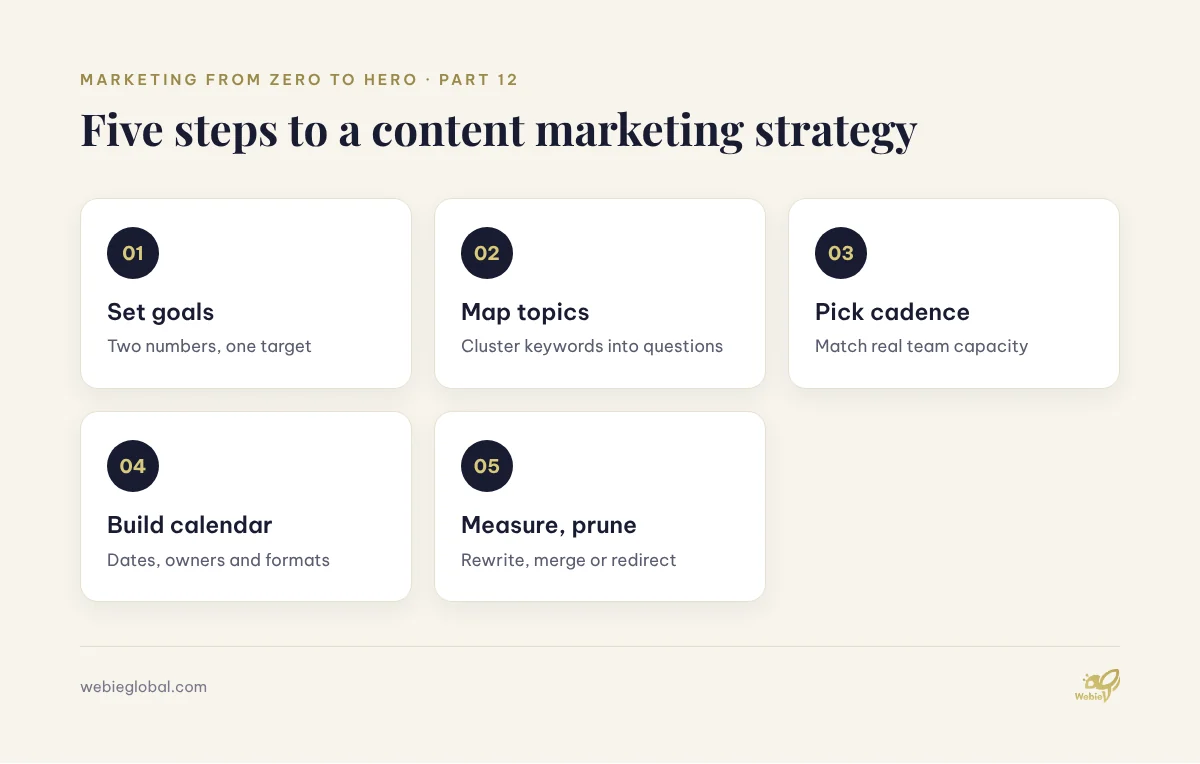
Step 1 — Set goals your content marketing strategy can defend
Vague goals produce vague content. So pick two numbers and one qualitative target for the next two quarters, then write them where the team can see them.
For example: forty qualified enquiries from organic search, twelve published cluster pages, and a recognised voice in your two strongest markets. Each of those can be checked. As a result, nobody argues about progress in month four.
Our guide to setting marketing goals and KPIs compares the OKR and SMART formats in detail. The shortcut, though, is blunt. If a goal cannot be read off a dashboard, treat it as a wish rather than a goal.
Budget belongs in the same conversation. A plan for twenty articles a quarter needs a writer, an editor and a designer. Our marketing budget planning guide covers how to size that honestly before you commit.
Step 2 — Turn keyword clusters into topics
Group questions, not keywords
One keyword is not one article. Instead, group the terms that share an intent and would be answered by the same page. Each group becomes a topic with one primary keyword and three to six variants.
Then write the topic as a question a buyer would actually ask. “How do we pick between nearshore and offshore development?” produces a better brief than “nearshore vs offshore”. Because the question carries the intent, the writer knows what to answer.
Write a brief the writer can actually use
A topic is not a brief. Consequently the gap between the two is where most calendars quietly stall. Keep the brief to half a page: the question, the reader, the primary keyword, three points the piece must make, and two internal links to include.
Then add one line on the angle. For example, “argue that cadence beats volume” tells the writer what to defend. Without that line, you get a competent summary of the internet instead of a point of view.
Pick formats before volume
Format follows funnel stage. Early questions suit guides and explainers. Late questions suit comparisons, checklists and case-style walkthroughs. Therefore decide the format at planning time, not while drafting.
| Funnel stage | Format that fits | Typical length |
|---|---|---|
| Early | Guide or explainer | 1,200–1,800 words |
| Middle | Comparison or framework | 1,500–2,000 words |
| Late | Checklist, FAQ or service page | 600–1,200 words |
Google’s guidance on creating helpful, people-first content is a useful filter here. If a topic cannot support a page that genuinely helps someone, drop it before it reaches the calendar.
Step 3 — Choose a cadence you can sustain
Cadence beats volume. Two solid articles a month, published for a year, outperform eight in January and silence afterwards. Search engines reward consistency, and so do readers.
Pick the cadence from your real capacity, not your ambition. One part-time marketer realistically ships two to three pieces a month, including review cycles. A small team with a freelance writer manages four to six.
- Weekly. Only with a dedicated writer and a stocked backlog.
- Fortnightly. The sweet spot for most European SMEs.
- Monthly. Workable, as long as each piece is substantial.
Then protect the cadence with a buffer. Keep two finished pieces in reserve, because holidays, launches and sick leave will happen. Without that buffer, the first busy week breaks the schedule.
Finally, separate publishing from promotion. Each piece needs a second slot in the calendar for the newsletter, the LinkedIn post and the sales follow-up. Otherwise you publish into silence, and the article waits months for search to find it.
Step 4 — Build the editorial calendar
Columns every editorial calendar needs
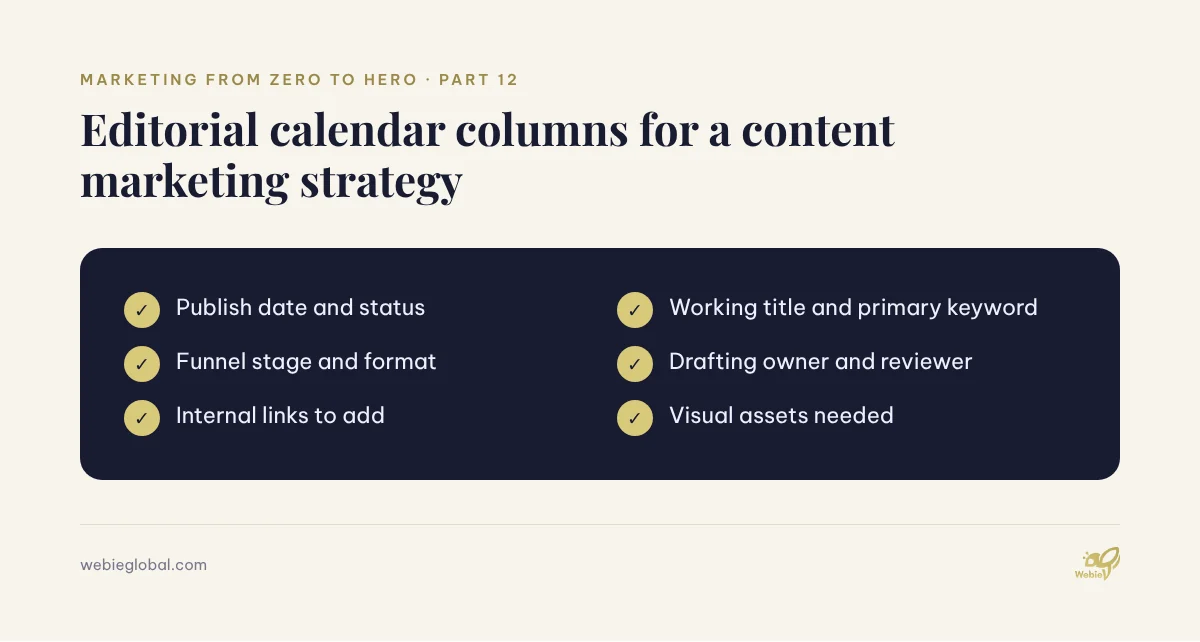
A calendar is a working document, so keep it narrow enough to update in two minutes. These columns cover almost every case:
- Publish date and status
- Working title and primary keyword
- Funnel stage and format
- Owner for drafting, and owner for review
- Internal links to add
- Visual assets needed
Keep it in whatever your team already opens daily. A shared sheet works. A board in your marketing tech stack works better, because status changes are visible without a meeting.
A twelve-week example
Plan one quarter at a time. Twelve weeks is long enough to build momentum, yet short enough to correct.
| Weeks | Published pieces | Cluster focus |
|---|---|---|
| 1–4 | 2 guides, 1 checklist | Core service topic |
| 5–8 | 1 comparison, 2 guides | Competing options |
| 9–12 | 1 FAQ page, 1 service page update | Decision-stage terms |
Also schedule the unglamorous work. Reserve one slot a month for updating an older page, since refreshing a piece that already ranks usually returns more than publishing a new one.
Step 5 — Measure, then prune
Review monthly, decide quarterly. Monthly you check whether pieces shipped on time. Quarterly you check whether they earned anything.
A scorecard for your content marketing strategy
Four numbers are enough: organic entrances per page, enquiries attributed to content, keyword positions for the cluster, and time from brief to publish. The last one is the leading indicator, because a slow pipeline starves everything downstream.
Record them on the same page as the calendar, so the review takes ten minutes rather than an afternoon. Also note one sentence per quarter on what you learned. Over a year, those sentences become the real content marketing strategy document, since they reflect what your market responded to instead of what you assumed.
Then prune. Pages with no traffic after six months get one rewrite. If the rewrite fails too, merge them into a stronger page and redirect. Consequently your site stays small and credible instead of large and thin.
Make sure the pages can be found at all. Technical SEO basics covers crawling, indexing and site speed, and no publishing rhythm compensates for a page Google cannot reach. Eurostat’s data on how European enterprises use digital and social channels is a useful reality check on where your audience already spends attention.
Common content marketing strategy mistakes
Five patterns cause most of the damage. Watch for them in your own calendar.
- Planning a year at once. Markets move, so anything past twelve weeks is a guess.
- No named owner. Shared ownership means nobody writes it.
- Publishing without internal links. Each new page should link to two older ones, and earn one link back.
- Ignoring updates. Refreshing a ranking page is cheaper than writing a new one.
- Measuring traffic only. Traffic without enquiries tells you the topics were wrong.
Content marketing strategy FAQ
How long before a content marketing strategy shows results?
Expect six to nine months before organic search contributes steady enquiries, and three months before you can see directional movement. New sites take longer. However, the pages you publish in month one keep working in month twenty, which is why the curve steepens rather than flattens.
How many articles a month does an SME need?
Two to four substantial pieces, consistently. A team that publishes two good articles a month for a year will have twenty-four assets and a clear topical footprint. Volume beyond that helps only once the review and promotion pipeline keeps up.
Who should own the editorial calendar?
One person, named, with the authority to move dates. That owner does not have to write everything. Instead they chase briefs, protect the cadence and decide what gets cut when a week goes wrong.
Does AI change the content marketing strategy?
It changes production speed, not the strategy itself. You still need the right topics, a real point of view and an editor. So treat drafting tools as leverage on the calendar, and keep a human accountable for accuracy and voice.
Get your content marketing strategy reviewed
A plan only pays off once pages ship, get found and generate enquiries. If your calendar has stalled or your topics never made it past a spreadsheet, our team can review the plan and take production off your hands. Explore our services or email huyen.dang@webieglobal.com for a short review of your current calendar.
Series navigation: this is part 12 of Marketing from Zero to Hero. Previously: Keyword Research for B2B: A Practical Guide. Next: Local & Multi-Language SEO in Europe.