




Multi-language SEO in Europe decides whether a buyer in Munich, Rotterdam or Lyon ever finds your website. One English page rarely wins all three markets, because each audience searches in its own language. It also judges you against local competitors. So the real question is not whether to localise, but how far to go and in which order.
This guide gives you a practical sequence. First you will see how local SEO differs from language SEO. Then you get five steps, a rollout checklist and the mistakes that waste the most budget. Everything here suits a small marketing team, so you do not need an in-house translation department.
What multi-language SEO actually means in Europe
The EU recognises 24 official languages, and buyers rarely switch to English when a local option exists. Multi-language SEO therefore means running one search strategy across several language versions of the same site. Each version targets its own keywords, its own intent and its own competitor set.
Local SEO is narrower. It covers signals that help you rank for searches tied to a place, such as a city or region. Both disciplines overlap, yet they demand different work. Because of that overlap, teams often merge them into one vague project. They then lose track of what actually moved the needle.
Scope matters more than ambition here. A five-language launch sounds impressive, yet it usually spreads one budget across five weak sites. Instead, rank your markets by existing demand, deal size and the sales capacity you already have. Then launch the strongest one, learn from it and reuse that playbook.
Local SEO and multi-language SEO solve different problems
Start by asking where your buyer expects you to sit. Proximity matters for some services, while language matters for almost all of them.
Where local signals matter most
Local signals win when the buyer wants a supplier nearby. Google itself names relevance, distance and prominence as the three drivers of local results (Google Business Profile Help). Therefore a verified profile, accurate opening hours and genuine reviews often matter more than another blog post. For example, a Berlin studio serving Berlin clients should fix its profile first.
Where language signals matter most
Language signals win when the buyer searches in their mother tongue for a service that travels well. Software development, SEO retainers and UX audits all travel well. So a Dutch prospect may happily hire a team abroad, yet they will still start the search in Dutch. In that case translated landing pages beat a local address.
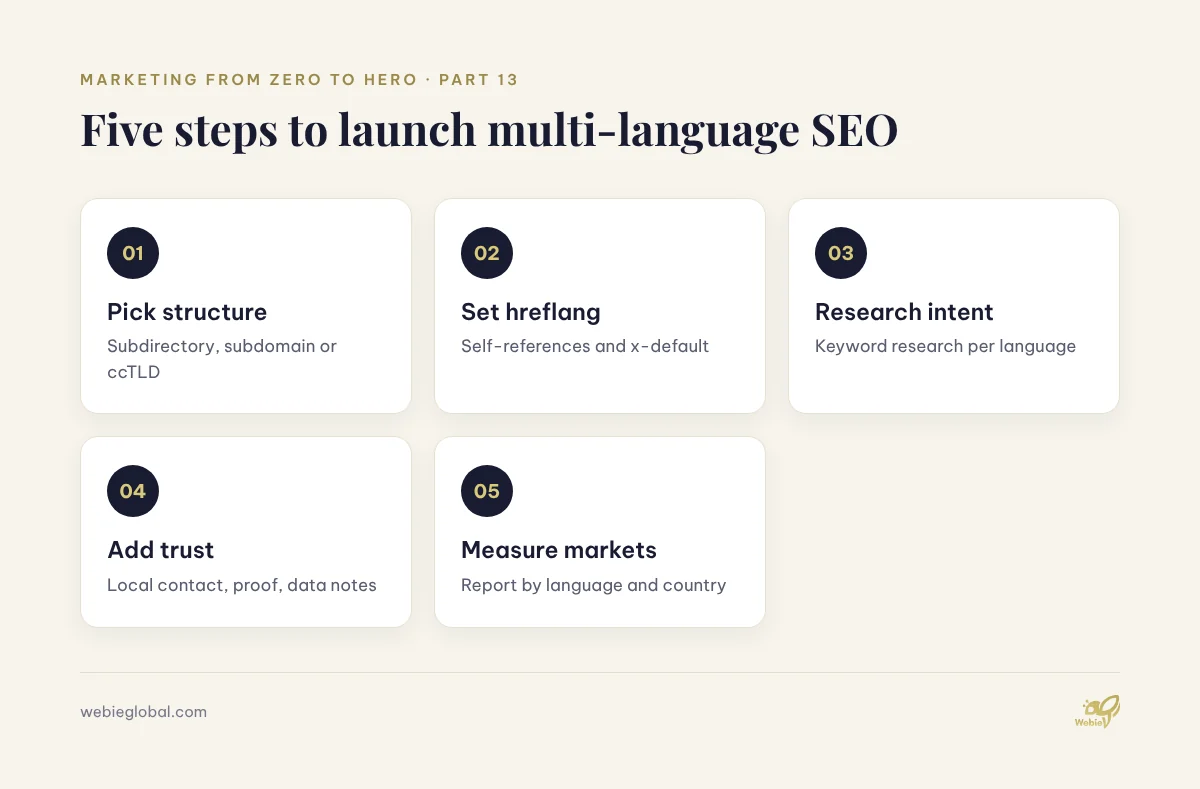
Step 1 — Choose a URL structure for each market
Pick the structure before you commission a single translation. Changing it later costs redirects, rankings and patience. Three options cover almost every SME case, so compare them against your team size rather than your ambition.
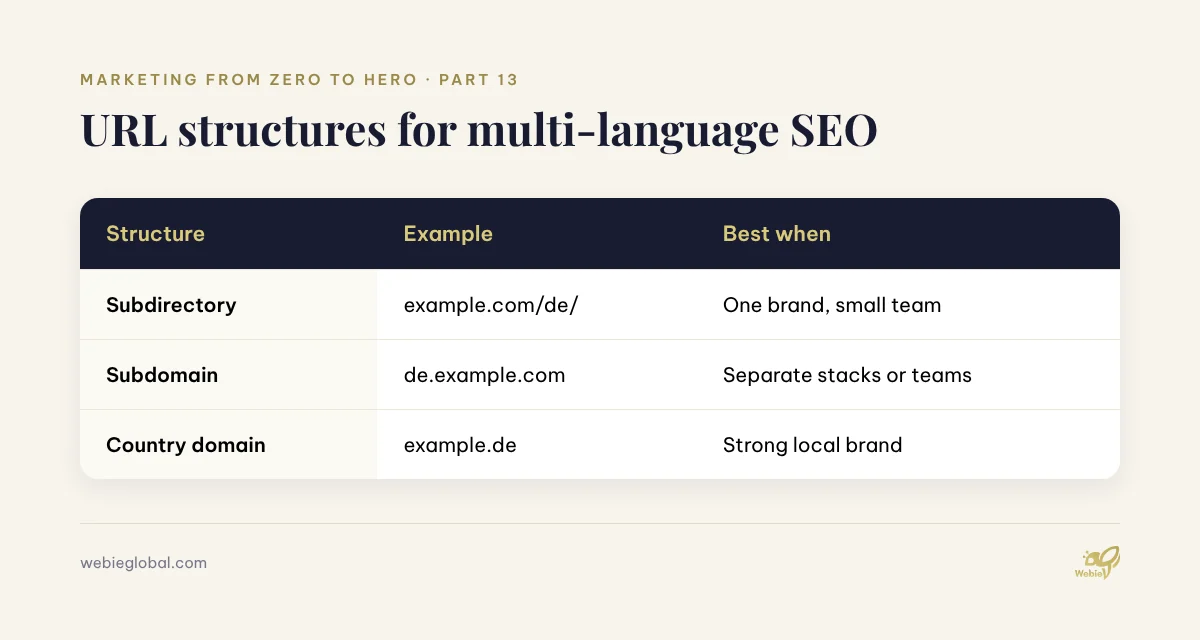
Subdirectories suit most European SMEs. They inherit the authority of one domain, so a new German section usually ranks faster than a brand-new country domain. In addition, one CMS and one analytics property keep reporting simple. Our post on technical SEO basics covers the crawling side of that decision.
Language and country are not the same decision either. One German page can serve Germany, Austria and Switzerland, so you do not need three sections on day one. If pricing or legal terms differ by country, however, split later with region-specific hreflang codes. That order keeps your early rollout cheap.
Step 2 — Get hreflang annotations right
Hreflang tells Google which version to show to which audience. Google accepts it in HTML head tags, HTTP headers or an XML sitemap, and using more than one method adds nothing (Google Search Central). So pick the method your CMS handles cleanly, then stay with it.
Four rules prevent most hreflang failures. First, every version must list itself and all its siblings, because Google may ignore one-way references. Second, use ISO 639-1 language codes with optional ISO 3166-1 Alpha 2 region codes, so German for Belgium becomes de-BE. Third, always use absolute URLs. Finally, add an x-default version for visitors whose language you do not cover yet.
Validation deserves a calendar slot of its own. Crawl every language version monthly, because a single template change can wipe out a whole annotation set. If rankings drift in one country while the others hold steady, check hreflang before you rewrite any copy.
Step 3 — Translate search intent, not just words
A literal translation of your English keyword list will mislead you. Volume, phrasing and funnel stage all shift between markets. For example, German buyers often search for a precise job title, while British buyers search for an outcome.
So run keyword research once per language instead of translating a spreadsheet. Our guide to keyword research for B2B explains the method step by step. Then map each keyword to one page, and rewrite that page for the market rather than translating it line by line.
Tone travels badly too. German business copy generally rewards precision, while Dutch readers prefer directness. As a result, a page that converts in London can feel vague in Hamburg, even when the translation is accurate.
Step 4 — Build local trust signals in each market
Translated copy alone rarely convinces a cautious European buyer. They look for proof that you can work in their market, in their language and under their rules. Therefore every language version needs its own trust layer.
- A contact route in that language, so nobody has to switch
- Engagement models explained in local commercial terms
- A data-processing note the buyer can actually read
- Project examples from a comparable market, because relevance builds confidence
- Response times stated for the relevant time zone
Our earlier post on GDPR-compliant marketing covers the consent mechanics in more detail. In short, a trust layer costs little, yet it decides whether a translated page earns a reply.
Step 5 — Measure results market by market
One blended traffic number hides everything that matters. Instead, split every report by language version and by country. Then you can see which market earns its investment and which one still needs patience.
Track impressions, average position, conversion rate and pipeline value for every market. Because each market starts from a different baseline, compare it against itself over time rather than against the others. Also watch indexing closely, since a broken hreflang set often surfaces as the wrong language ranking in the wrong country.
Attribution needs a local view too. A buyer in France may discover you through a French blog post, then convert on an English pricing page. So look at assisted conversions per language, not only last-click. Otherwise the content that opens a market looks worthless in your dashboard.
A multi-language SEO rollout checklist
Use this checklist before you launch any new language version. It keeps a multi-language SEO rollout honest, even when the deadline slips.
| Phase | What to do | Done when |
|---|---|---|
| Decide | Choose URL structure and launch markets | Structure documented and approved |
| Research | Run keyword research per language | Keyword map exists per market |
| Build | Create pages and hreflang annotations | Self-references validate cleanly |
| Localise | Rewrite copy and add trust signals | Native reviewer signs off |
| Launch | Submit sitemaps and localise internal links | Pages appear in the target country |
| Review | Report by market every month | Owner named for each market |
Common multi-language SEO mistakes to avoid
Most multi-language SEO projects fail for predictable reasons. The table below lists the five we meet most often, so you can plan around them early.
| Mistake | Why it hurts | Better move |
|---|---|---|
| Machine translation only | Thin copy, weak intent match | Native rewrite of key pages |
| Missing hreflang return links | Google drops the annotations | Validate every language version |
| One keyword list for all markets | Wrong terms, wrong funnel stage | Research each language separately |
| Auto-redirect by IP address | Blocks crawlers, annoys visitors | Offer a visible language switcher |
| Launching every language at once | Budget spread too thin | Start with two strong markets |
FAQ
Is multi-language SEO worth it for a small team?
Yes, if you start small. Two languages done properly beat six done badly, because quality drives both rankings and trust. So pick the market with the clearest pipeline first.
Do I need a local address for local SEO in each country?
Not always. You need one only when you genuinely serve customers at a location, since Google expects a real presence there. Otherwise invest in language versions instead.
Can I use machine translation for multi-language SEO?
Use it as a first draft, then ask a native speaker to rewrite it. Machine output usually misses the intent behind local keywords. As a result, pages read fluently yet rank poorly.
Should I translate the whole site or start with key pages?
Start with the pages that earn money. Usually that means the homepage, two or three service pages and one strong guide. Then expand once the first set shows traction.
How long does multi-language SEO take to show results?
Expect three to six months for a new language version on an established domain. New domains take longer, because they must earn authority first. Therefore agree reporting expectations before launch.
Ready to scale multi-language SEO with a partner?
If multi-language SEO sits on your roadmap but never in your calendar, a dedicated team can carry the work. Webie Global pairs European-standard process with Southeast Asian delivery capacity, so you keep momentum without hiring in every market. Explore our services or email huyen.dang@webieglobal.com to discuss scope, timelines and engagement models.
Series navigation — this is Part 13 of Marketing from Zero to Hero. Previously we covered Content Marketing Strategy & Editorial Calendar. Next, LinkedIn Marketing for B2B Decision Makers.