


Your marketing tech stack is the set of tools you use to reach customers, capture leads and measure results. For most SMEs, that means a website, a CRM, an email platform and an analytics tool that all work together. This guide shows you how to build a marketing tech stack that fits your budget, connects your data and grows with your business.
Earlier posts in this series covered your marketing strategy, your marketing goals and your marketing budget. Now we turn that strategy into the practical toolkit that runs your day-to-day marketing.
The aim here is not more software. Instead, it is the right software, set up well and actually used. So we focus on jobs first and tools second.
What a Marketing Tech Stack Is — and Why SMEs Need One
A marketing tech stack, often called a martech stack, is simply the collection of software that supports your marketing. Some tools attract visitors, others convert them, and a few help you measure what works. Together, they form one connected system rather than a pile of separate logins.
The market is crowded. According to chiefmartec, there were 15,384 marketing technology tools in 2025, roughly 100 times more than in 2011. As a result, choice is not the problem. The real problem is focus.
Waste is common, too. Gartner has found that marketers use only about a third of their martech stack’s capabilities. In other words, most teams pay for features they never touch. A lean marketing tech stack therefore beats a large one that nobody fully understands.
Your setup also changes as you grow. Early on, a handful of connected tools is enough. Later, you add depth in the areas that clearly drive revenue. So treat the stack as a living system, not a one-time purchase.
The Core Layers to Cover
You do not need every category. However, most SMEs need five core layers. Think of each layer as a job to be done, then choose one tool per job.
| Layer | Job it does | Common tool types |
|---|---|---|
| Website & CMS | Turn visitors into leads | WordPress, landing page builder |
| CRM | Store and manage contacts | HubSpot, Pipedrive, Zoho |
| Email & automation | Nurture leads over time | Mailchimp, Brevo, Klaviyo |
| Analytics | Measure what works | GA4, Matomo |
| Ads & social | Reach new audiences | Google Ads, Meta, LinkedIn |
Start with the website and the CRM. These two form the backbone of any marketing tech stack, because they hold your traffic and your contacts. Then add email, analytics and ads as you grow.
The value is not in any single tool. Rather, it lies in how the tools connect. When your website passes leads straight into your CRM, and your CRM feeds your email tool, you save hours of manual work and lose far fewer leads along the way.
How to Build Your Marketing Tech Stack in Six Steps
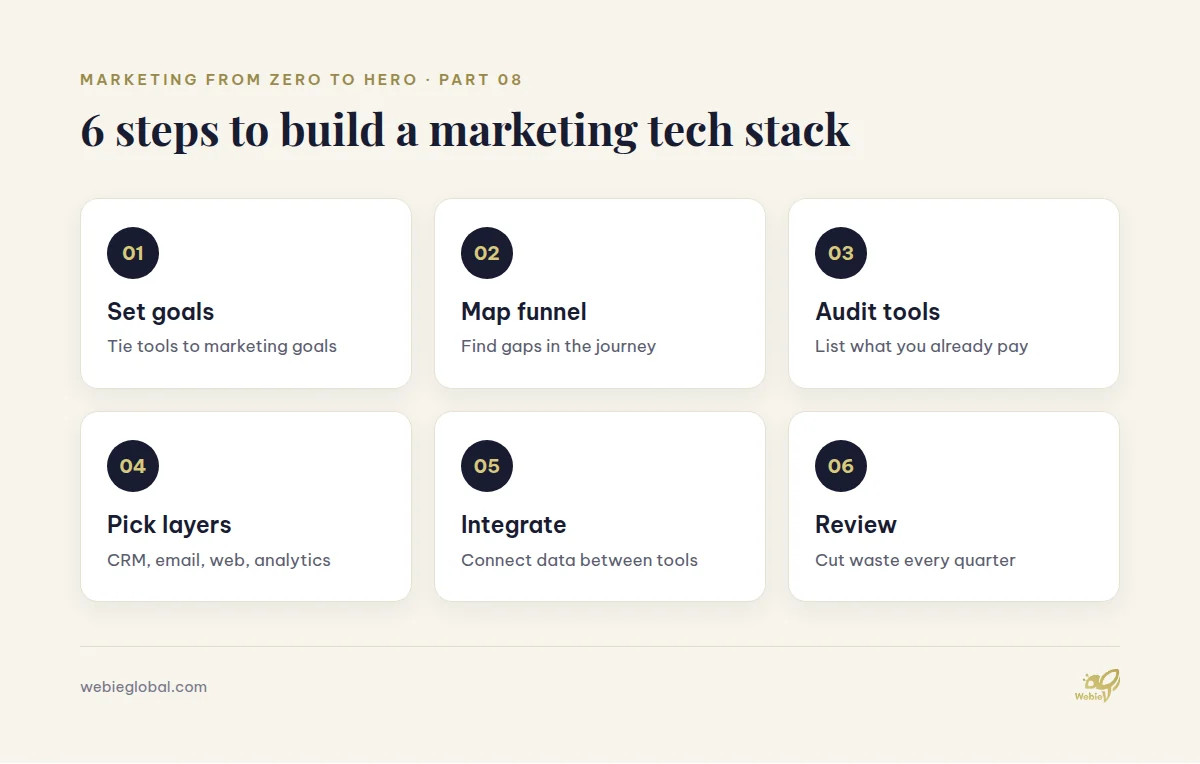
Building a marketing tech stack works best as a simple, repeatable process. So follow these six steps in order.
- Set clear goals. First, tie every tool to a marketing goal, such as more leads or faster follow-up. If a tool serves no goal, you do not need it yet.
- Map your funnel. Then study the full customer journey and find the gaps where you lose people. Each gap points to a job a tool should do.
- Audit what you have. List every tool you already pay for. Often, you will find overlaps and forgotten subscriptions that quietly drain the budget.
- Pick your core layers. Choose one tool per job: website, CRM, email, analytics and ads.
- Integrate the data. Connect your tools so contacts and events flow between them automatically. Above all, avoid manual exports that go stale within days.
- Review and cut. Finally, check usage and cost every quarter, then remove what you do not use.
This order matters. Because goals and funnel come first, your marketing tech stack stays tied to outcomes instead of trends.
Choosing Tools: Build, Buy or Bundle
When you choose a tool, you usually have three options. Each one suits a different stage.
- Buy best-of-breed. Pick the strongest tool for each job. This gives you power, but it needs more integration work.
- Buy a bundle. Use one platform that covers several jobs, such as CRM plus email. This is simpler, though sometimes less flexible.
- Build custom. Create your own tool or integration when off-the-shelf options do not fit. This suits unusual workflows, yet it costs more to maintain.
For most SMEs, a small bundle plus one or two specialist tools works well. As a rule, favour tools that integrate easily over tools with the longest feature list. In practice, integration saves more time than extra features do.
A Starter Marketing Tech Stack for a Small Team
If you are starting from zero, keep it small. A first marketing tech stack for a lean SME often needs just four connected tools, and you can add more later.
- Website on a CMS, such as WordPress, with clear landing pages and forms.
- A CRM that stores every lead and logs each conversation in one place.
- Email and automation, for newsletters and simple follow-up sequences.
- Analytics, such as GA4, to see which pages and channels bring leads.
For example, a ten-person B2B firm might pair a WordPress site with an affordable CRM, an email platform and GA4. That setup covers the whole journey, from first visit to signed deal. Later, as budgets grow, the same team can add paid ads, a scheduling tool or live chat. Because the core is already connected, each new tool plugs in without a rebuild.
A Marketing Tech Stack Checklist for SMEs
Use this checklist before you add a new tool or renew a contract. It also works as a quarterly review of your marketing tech stack.
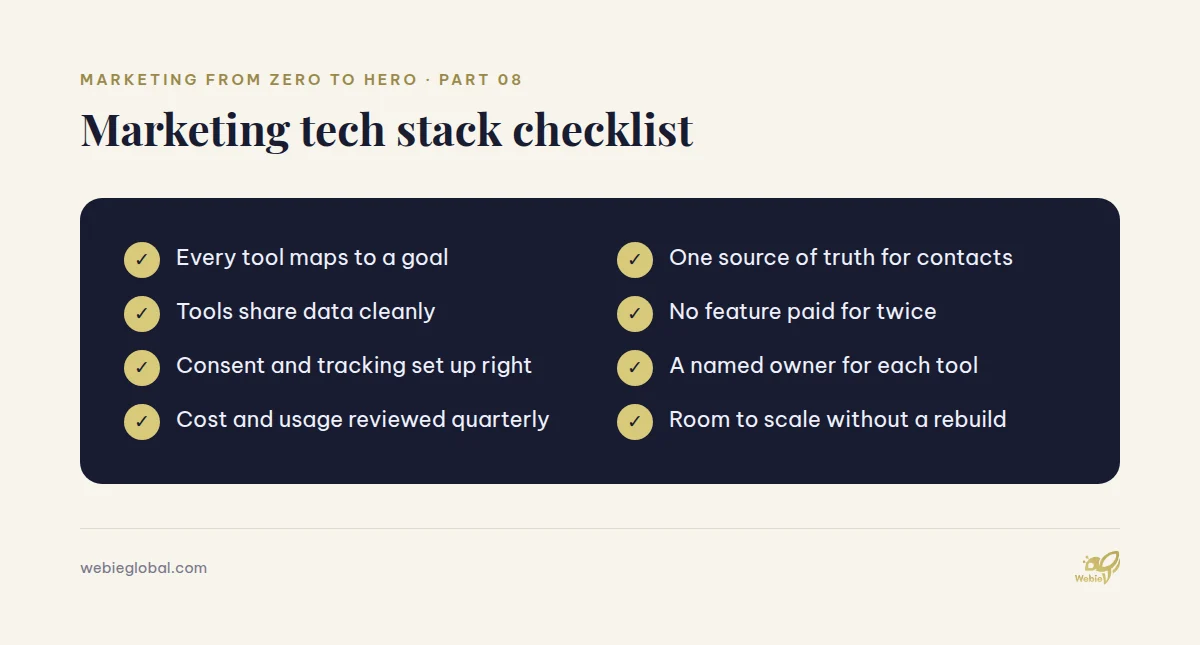
- Every tool maps to a clear marketing goal.
- One source of truth holds your contacts, usually the CRM.
- Tools share data cleanly, without manual copy-paste.
- You never pay for the same feature twice.
- Consent and tracking work correctly on your site.
- Each tool has a named owner on your team.
- You review cost and usage every quarter.
- The stack can scale without a full rebuild.
If most boxes are ticked, your marketing tech stack is healthy. If not, fix the gaps first, before you buy anything new.
Common Mistakes to Avoid
Even careful teams repeat a few errors. So watch out for these:
- Buying tools before goals. A shiny tool cannot fix an unclear strategy.
- Ignoring integration. Disconnected tools create double work and messy data.
- Overlapping subscriptions. Two tools often do the same job, so you pay twice.
- Skipping consent. Analytics and ad pixels need proper consent, as our GDPR marketing guide explains.
- Never reviewing. Needs change, therefore your tools must change too.
Most of these come back to one habit: adding tools faster than you retire them. For this reason, a short quarterly review keeps your marketing tech stack lean.
Who Owns the Marketing Tech Stack in Your Team?
Tools fail quietly when nobody owns them. Therefore, give each part of your marketing tech stack a clear owner, even in a small team.
| Area | Typical owner | Review rhythm |
|---|---|---|
| Website & tracking | Web developer or agency | Every release |
| CRM & data | Marketing or sales lead | Monthly |
| Email & automation | Marketing lead | Monthly |
| Tool costs & contracts | Managing director | Quarterly |
In addition, write down who does what on one short page. As a result, new hires follow the same rules, and no tool drifts along unmanaged.
FAQ
Does a small SME need a marketing tech stack?
Yes, though it can be tiny. Even a website, a CRM and an email tool already count as a marketing tech stack. The goal is a connected setup, not a long list of software.
How much should the tools cost?
It depends on your stage. Many SMEs run a solid setup for a modest monthly fee by starting with free or entry tiers. As you grow, spend rises with the value that each tool returns.
What is the best marketing tech stack for B2B?
There is no single best marketing tech stack. However, most B2B teams start with a CRM, an email platform, LinkedIn and analytics, then add tools as their funnel matures.
How often should I review it?
Once a quarter works for most teams. A short review catches unused tools, overlaps and rising costs before they add up.
Build a Marketing Tech Stack That Scales
A good marketing tech stack should grow with you, not hold you back. It starts small, connects cleanly, and adds tools only when a real need appears. Webie Global helps European and international businesses design and connect their marketing tech stack, from web development and SEO to CRM setup and dedicated teams. We work in English, with clear processes, GDPR-aware practices and flexible engagement models. Explore our services.
If you want a second pair of eyes on your tools or integrations, contact our team at huyen.dang@webieglobal.com.
Series navigation — Marketing from Zero to Hero: Previous: GDPR-Compliant Marketing: What SMEs Must Know · Next: Website as a Sales Asset: Conversion-First Design.